Book Search:  


Google full text of our books:

bookjacket

The Ceremonial City:
Toulouse Observed, 1738-1780
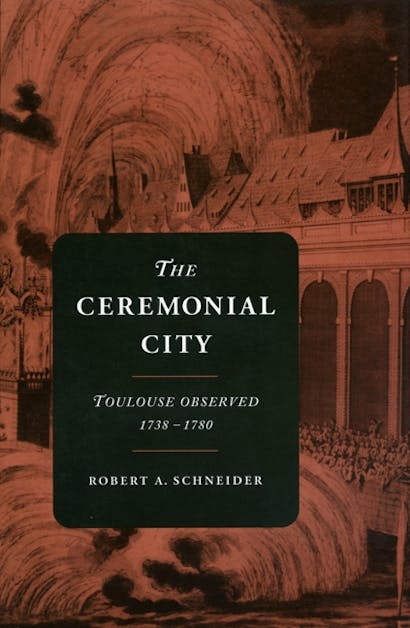
Robert A. Schneider

Paper | 1996 | This book is out of print | ISBN13: 978-0-691-03464-5
212 pp. | 6 x 9 | 4 tables 1 fig. 2 maps
Cloth | 1995 | This book is out of print | ISBN13: 978-0-691-03465-2
152 pp. | 5 x 8 | 6 halftones 1 fig. 2 maps

e-Book | 2001 | $9.95 (Microsoft Reader format) | ISBN: 978-1-4008-0710-9
e-Book | 2001 | $9.95 (Adobe Reader format) | ISBN: 978-1-4008-0712-3

| Reviews | Table of Contents

From public executions to religious processions to political festivities, Toulouse's ceremonial life was remarkably rich in the decades prior to the French Revolution. In an engaging portrait that conveys this provincial city in all its splendor and misery, Robert Schneider explores how Toulouse's civic and community life was represented in the stagings of various ceremonies. His inquiry is based on the unpublished diaries of Pierre Barthès, a Latin tutor who was both a devout Catholic and a monarchist, and who recorded forty years of public activity in ways that reflected the mounting social tensions of his times. By analyzing Barthès's accounts, Schneider demonstrates how the variety of ceremonial forms embodied different ritual dynamics and represented contrasting values.

The author focuses most intently on the differences between the solemn religious procession, which was highly participatory and represented local concerns, and the more celebratory festival, which vaunted the monarchy and turned the people into passive spectators. He examines the theatrical nature of often hastily orchestrated religious parades winding through neighborhood streets, then considers the monarchy's use of plazas for staged entertainment, particularly for awe-inspiring displays of fireworks. Schneider argues that the festival proved a successful tool in imposing the symbols of the centralized state on Toulouse's public life, but that both the procession and the festival incorporated powerful ceremonial forms that proved politically useful for the Revolution.

Reviews:

"[Robert Schneider] has captured the festival in all of its color and diversity with an evocative style that stands as a significant contribution to cultural history. Readers will find the immediacy of place, pageant, and popular ritual behavior compelling."--Robert Forster, The Johns Hopkins University

"Schneider sees no convergence of popular and elite culture. He also rejects the view of ritual as antithetical to modernity and convincingly suggests that part of the success of Revolutionary ceremonial was the use it made of traditional techniques. This useful book should cause the reappraisal of some widely-held general assumptions."--Journal of European Studies

Endorsement:

"Systematic and long-term treatments of rituals in public life are rare. Robert Schneider significantly enlarges our understanding of eighteenth-century urban life and people."--Lawrence Bryant, California State University-Chico

Table of Contents:

ACKNOWLEDGMENTS ix
INTRODUCTION 3
CHAPTER ONE The Observer and His Diary 17
CHAPTER TWO The City 41
CHAPTER THREE Justice in the Streets 75
CHAPTER FOUR Public Devotions 111
CHAPTER FIVE Political Festivities 149
CONCLUSION Thinking about the Ceremonial City 175
INDEX 195

Subject Area:

Hardcover published in 1995

Our e-Book editions are available from these online vendors:

File created: 4/23/2008

Questions and comments to: webmaster@press.princeton.edu
Princeton University Press

ONLINE BOOK SALE
New Book E-Mails
New In Print
Subjects
Catalogs
Series
Sample Chapters
Podcasts/Vodcasts
Recent Awards
E-Books
Online Books
Online Ordering
For Reviewers
Permissions
Class Use
About Us
Contact Us
European Office
Links
F.A.Q.
Home Page
Send me emails
about new books in:
European History
More Choices
Email:
Country:
Name: