Book Search:  


Google full text of our books:

bookjacket

Desire in the Renaissance:
Psychoanalysis and Literature
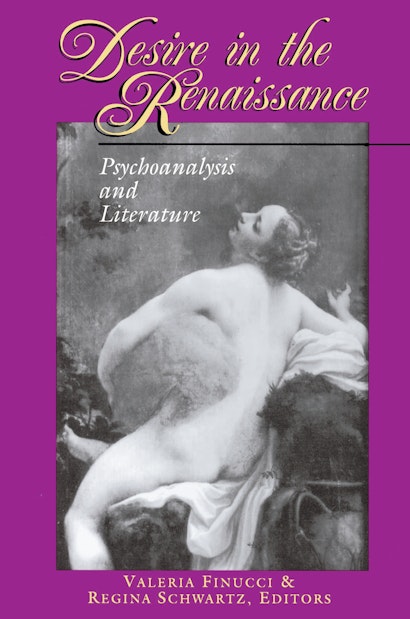
Edited by Valeria Finucci & Regina Schwartz

Paper | 1994 | $37.50 / £22.50
272 pp. | 6 x 9

e-Book | 2001 | $14.95 (Microsoft Reader format) | ISBN: 978-1-4008-0227-2
e-Book | 2001 | $14.95 (Adobe Reader format) | ISBN: 978-1-4008-0229-6

Shopping Cart | Reviews | Table of Contents

Google full text of this book:
 

Drawing on a variety of psychoanalytic approaches, ten critics engage in exciting discussions of the ways the "inner life" is depicted in the Renaissance and the ways it is shown to interact with the "external" social and economic spheres. Spurred by the rise of capitalism and the nuclear family, Renaissance anxieties over changes in identity emerged in the period's unconscious--or, as Freud would have it, in its literature. Hence, much of Renaissance literature represents themes that have been prominent in the discourse of psychoanalysis: mistaken identity, incest, voyeurism, mourning, and the uncanny. The essays in this volume range from Spenser and Milton to Machiavelli and Ariosto, and focus on the fluidity of gender, the economics of sexual and sibling rivalry, the power of the visual, and the cultural echoes of the uncanny. The discussion of each topic highlights language as the medium of desire, transgression, or oppression.

The section "Faking It: Sex, Class, and Gender Mobility" contains essays by Marjorie Garber (Middleton), Natasha Korda (Castiglione), and Valeria Finucci (Ariosto). The contributors to "Ogling: The Circulation of Power" include Harry Berger (Spenser), Lynn Enterline (Petrarch), and Regina Schwartz (Milton). "Loving and Loathing: The Economics of Subjection" includes Juliana Schiesari (Machia-velli) and William Kerrigan (Shakespeare). "Dreaming On: Uncanny Encounters" contains essays by Elizabeth J. Bellamy (Tasso) and David Lee Miller (Jonson).

Review:

"Desire in the Renaissance is impressive in its range, and shows how comprehensive the use of psychoanalytic theory in literary criticism has become. At their best, the essays demonstrate the power of psychoanalysis to elucidate the convoluted workings of literary language, and argue for its peculiar compatibility with the dizzying gamesmanship of early modern texts."--Katy Emck, Times Literary Supplement

Endorsement:

"The new historicism, which in recent years has become the predominate mode of reading the Renaissance, rarely manages to account for the 'literariness' of literary texts. I see [this book] as redressing the new historicism's sin of omission."--Giuseppe F. Mazzotta, Yale University

Table of Contents

Subject Areas:

Shopping Cart:

For customers in the U.S., Canada, Latin America, Asia, and Australia

Paper: $37.50 ISBN13: 978-0-691-00100-5

For customers in Europe, Africa, the Middle East, and India

Paper: £22.50 ISBN13: 978-0-691-00100-5

Our e-Book editions are available from these online vendors:

Prices subject to change without notice

File created: 7/1/2008

Questions and comments to: webmaster@press.princeton.edu
Princeton University Press

New Book E-Mails
New In Print
Subjects
Catalogs
Series
Sample Chapters
Podcasts/Vodcasts
Recent Awards
E-Books
Online Books
Online Ordering
For Reviewers
Permissions
Class Use
About Us
Contact Us
European Office
Links
F.A.Q.
Home Page
Send me emails
about new books in:
Comparative Literature
Psychology
Gender Studies
More Choices
Email:
Country:
Name: