Book Search:  


Google full text of our books:

bookjacket

The Cybernetic Theory of Decision:
New Dimensions of Political Analysis
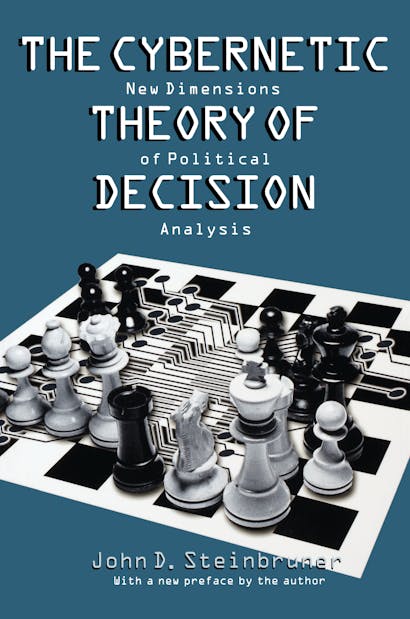
John D. Steinbruner

With a New Preface by the Author

Paper | 2002 | $28.95 / £19.95
392 pp. | 6 x 9

e-Book | 2002 | $28.95 | ISBN: 978-1-4008-2379-6

Shopping Cart | Reviews | Table of Contents

LEARN MORE ABOUT PRINCETON'S SPECIAL SALE

Google full text of this book:


Paper $10.00
65% off regular price

For customers in the
U.S. and Canada only

In this classic work, John Steinbruner argues that the time is ripe for exploration of a new theoretical perspective on the decision-making process in government. He suggests that the cybernetic theory of decision as developed in such diverse fields as information theory, mathematical logic, and behavioral psychology generates a systematic but non-rational analysis that seems to explain quite naturally decisions that are puzzling when viewed from the rational perspective. When combined with the basic understanding of human mental operations developed in cognitive psychology, the cybernetic theory of decision presents a striking picture of how decision makers deal with the intense uncertainty and fundamental value conflicts that arise in bureaucratic politics. To illustrate the advantages of using cybernetic theory, Steinbruner analyzes the issue of sharing nuclear weapons among the NATO allies.

Reviews:

"A stimulating and challenging work, almost two books in one, which applies cybernetics and psychology to the politics of the multilateral nuclear force and the nuclear sharing issue in the period of 1956-1964. Steinbruner's important and creative study successfully adds a new dimension to our understanding of decision-making."--Foreign Affairs

"Likely to prove one of those few path-breaking efforts of conceptual synthesis which will be influencing our thinking about government and policy-making for many years to come."--I. M. Destler, Arms Control Today

Table of Contents:

List of Figures ix
Preface to the Second Paperback Edition xi
Preface xxi
Chapter 1: Introduction 3
PART ONE: PARADIGMS OF THE DECISION PROCESS
Chapter 2: The Analytic Paradigm 25
Chapter 3: The Cybernetic Paradigm 47
Chapter 4: Cognitive Processes 88
Chapter 5: Politics and Policy 140
PART TWO: THE POLITICS OF NUCLEAR SHARING 1956-1964
Chapter 6: Strains in the Alliance: Genesis of a Two-Value Problem 153
Chapter 7: The Development of Nuclear Sharing Proposals: 1956-1960 173
Chapter 8: The Rise of the Multilateral Force: 1961-1963 199
Chapter 9: Asendancy and Sudden Death of the Multilateral Force: 1963-1964 327
Chapter 10: Epilogue: Conclusions and Implications 327
Bibliography 343
Index 361

Subject Area:

Shopping Cart:

Paper $10.00
65% off regular price

Special online sale for customers in the U.S. & Canada only

For customers in the U.S., Canada, Latin America, Asia, and Australia

Paper: $28.95 ISBN13: 978-0-691-09487-8

For customers in Europe, Africa, the Middle East, and India

Paper: £19.95 ISBN13: 978-0-691-09487-8

Our e-Book editions are available from these online vendors:
Amazon Kindle Store
Other e-Book Formats

Prices subject to change without notice

File created: 10/18/2009

Questions and comments to: webmaster@press.princeton.edu
Princeton University Press

ONLINE BOOK SALE
New Book E-Mails
New In Print
PUP Blog
Subjects
Catalogs
Series
Sample Chapters
Podcasts/Vodcasts
Recent Awards
Google Settlement
E-Books
Online Books
Online Ordering
For Reviewers
Class Use
Permissions
About Us
Contact Us
European Office
Links
F.A.Q.
Home Page
Send me emails
about new books in:
Political Science and International Relations
More Choices
Email:
Country:
Name: