Book Search:  


Google full text of our books:

bookjacket

Concepts of Mass in Contemporary Physics and Philosophy
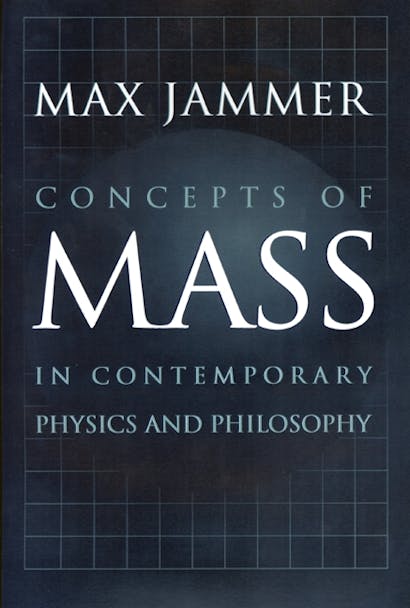
Max Jammer

Cloth | 1999 | $62.50 / £36.95
176 pp. | 6 x 9

e-Book | 2001 | $9.95 (Microsoft Reader format) | ISBN: 978-1-4008-0404-7
e-Book | 2001 | $9.95 (Adobe Reader format) | ISBN: 978-1-4008-0406-1

Shopping Cart | Reviews | Table of Contents

Google full text of this book:
 

The concept of mass is one of the most fundamental notions in physics, comparable in importance only to those of space and time. But in contrast to the latter, which are the subject of innumerable physical and philosophical studies, the concept of mass has been but rarely investigated. Here Max Jammer, a leading philosopher and historian of physics, provides a concise but comprehensive, coherent, and self-contained study of the concept of mass as it is defined, interpreted, and applied in contemporary physics and as it is critically examined in the modern philosophy of science. With its focus on theories proposed after the mid-1950s, the book is the first of its kind, covering the most recent experimental and theoretical investigations into the nature of mass and its role in modern physics, from the realm of elementary particles to the cosmology of galaxies.

The book begins with an analysis of the persistent difficulties of defining inertial mass in a noncircular manner and discusses the related question of whether mass is an observational or a theoretical concept. It then studies the notion of mass in special relativity and the delicate problem of whether the relativistic rest mass is the only legitimate notion of mass and whether it is identical with the classical (Newtonian) mass. This is followed by a critical analysis of the different derivations of the famous mass-energy relationship E = mc2 and its conflicting interpretations. Jammer then devotes a chapter to the distinction between inertial and gravitational mass and to the various versions of the so-called equivalence principle with which Newton initiated his Principia but which also became the starting point of Einstein's general relativity, which supersedes Newtonian physics. The book concludes with a presentation of recently proposed global and local dynamical theories of the origin and nature of mass.

Destined to become a much-consulted reference for philosophers and physicists, this book is also written for the nonprofessional general reader interested in the foundations of physics.

Reviews:

"The book reads likes an engaging, well-planned lecture, with many a historical aside and opinionated excursion."--Publishers Weekly

"A valuable and badly needed account that manages to be undogmatic, comprehensive and accessible. . . . I can strongly recommend this beautifully written and accessible book."--Andrew Pinsent, Physics World

"An interesting and stimulating mix of physics and philosophical issues. . .Jammer has produced a fascinating look into the nature of a quantity that most of us take for granted . . . and its also fun to read."--Barry R. Holstein, American Scientist

"[Jammer's] contributions to the conceptual foundations of physics have been, and continue to be, both fruitful and enlightening."--Jonathan Bain, Physics Today

Endorsements:

"Concepts of Mass in Contemporary Physics and Philosophy addresses an important issue, covering a large swathe of territory and presenting technical results in clear and accessible way. There is no comparable study of mass in the field, and the need for a synoptic review is obvious. Philosophers and historians of science, who often lack the technical expertise to evaluate the work of physicists, will find the book very useful. Physicists, too, will value the book, particularly because it brings together results that are widely dispersed in the literature."--Tim Maudlin, Rutgers University

"Professor Max Jammer's book is a significant and important contribution to the conceptual foundations of physics, especially in the manner in which it explores how the concept of mass occurs in the context of gravitational and space-time theories."--Ronald Anderson, Boston College

Table of Contents:

Preface vii
Acknowledgments xii
INTRODUCTION 3
CHAPTER 1 Inertial Mass 5
CHAPTER 2 Relativistic Mass 41
CHAPTER 3 The Mass-Energy Relation 62
CHAPTER 4 Gravitational Mass and the Principle of Equivalence 90
CHAPTER 5 The Nature of Mass 143
Index 169

Another Princeton book by Max Jammer:

Subject Areas:

VISIT OUR MATH WEBSITE or
PHYSICS & ASTRONOMY WEBSITE

Shopping Cart:

For customers in the U.S., Canada, Latin America, Asia, and Australia

Cloth: $62.50 ISBN13: 978-0-691-01017-5

For customers in Europe, Africa, the Middle East, and India

Cloth: £36.95 ISBN13: 978-0-691-01017-5

Our e-Book editions are available from these online vendors:

Prices subject to change without notice

File created: 7/1/2008

Questions and comments to: webmaster@press.princeton.edu
Princeton University Press

New Book E-Mails
New In Print
Subjects
Catalogs
Series
Sample Chapters
Recent Awards
E-Books
Online Books
Online Ordering
For Reviewers
Permissions
Class Use
About Us
Contact Us
European Office
Links
F.A.Q.
MATH SITE
PHYSICS AND
ASTRONOMY SITE
PUP Home
Send me emails
about new books in:
Physics
Mathematics
History of Science and Medicine, Philosophy of Science
Philosophy
More Choices
Email:
Country:
Name: