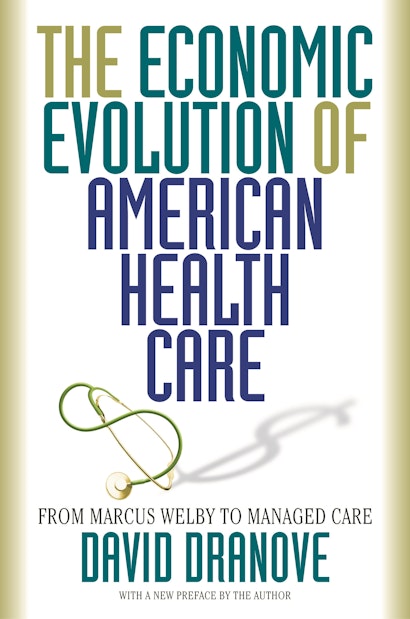
The American health care industry has undergone such dizzying transformations since the 1960s that many patients have lost confidence in a system they find too impersonal and ineffectual. Is their distrust justified and can confidence be restored? David Dranove, a leading health care economist, tackles these and other key questions in the first major economic and historical investigation of the field. Focusing on the doctor-patient relationship, he begins with the era of the independently practicing physician—epitomized by Marcus Welby, the beloved father figure/doctor in the 1960s television show of the same name—who disappeared with the growth of managed care. Dranove guides consumers in understanding the rapid developments of the health care industry and offers timely policy recommendations for reforming managed care as well as advice for patients making health care decisions.
The book covers everything from start-up troubles with the first managed care organizations to attempts at government regulation to the mergers and quality control issues facing MCOs today. It also reflects on how difficult it is for patients to shop for medical care. Up until the 1970s, patients looked to autonomous physicians for recommendations on procedures and hospitals—a process that relied more on the patient’s trust of the physician than on facts, and resulted in skyrocketing medical costs. Newly emerging MCOs have tried to solve the shopping problem by tracking the performance of care providers while obtaining discounts for their clients.
Many observers accuse MCOs of caring more about cost than quality, and argue for government regulation. Dranove, however, believes that market forces can eventually achieve quality care and cost control. But first, MCOs must improve their ways of measuring provider performance, medical records must be made more complete and accessible (a task that need not compromise patient confidentiality), and patients must be willing to seek and act on information about the best care available. Dranove argues that patients can regain confidence in the medical system, and even come to trust MCOs, but they will need to rely on both their individual doctors and their own consumer awareness.
"[Dranove] offers important insight into a complicated and critically important sector of our society."—Booklist
"[Dranove] raises interesting points on the benefits of managed care but does not hesitate to point out where MCOs can go wrong. While the book emphasizes the business aspect of healthcare, an economics degree is not necessary to understand the principles that are illustrated."—Library Journal
"When you ask people why they don't like managed care, they usually don't give clear answers . . . But most people haven't had particularly bad experiences themselves . . . So it's been hard for most of us to know just how managed health care really does stack up . . . It's no longer so hard, thanks to The Economic Evolution of American Health Care, by David Dranove. . . A wealth of information."—David R. Henderson, The Wall Street Journal
"Although everyone will not agree with the author's theories and conclusions, he offers important insight into a complicated and critically important sector of our society."—Booklist
"Many governments are actively considering market-based solutions to health care inflation. My message to them is simple: before you try to emulate much of what we have done, read David Dranove."—Jerome P. Kassirer, Canadian Medical Association Journal
"David Dranove acknowledges many of the problems of contemporary managed care but argues that, properly structured, it would be a very good idea."—Lawrence P. Casalino, New England Journal of Medicine
"An excellent book that makes accessible a great deal of interesting and relevant research. . . . It reviews a remarkable list of important policy issues in a very short space and provides sharp economic insight into each of them. Even more, it is written in clear, non-technical language. . . . I recommend it highly."—Alain C. Enthoven, Healthplan
"The Economic Evolution of American Health Care delivers a great deal of new and valuable information in a crisp, very readable style. It is an excellent primer on the state of the US health care industry and on the economics of competition in health care."—Sherry Glied, Health Economics
"David Dranove, one of the most skilled research economists working in health care, has written a lively, accessible book tracing the economic and technological forces that have transformed health care from a mom-and-pop operation to big business. In an era when managed care is hard to love, Dranove steps back and assesses how it happened, what it does (and doesn't do), and then offers sensible evidence-based recommendations on where to go from here."—Thomas G. McGuire, Boston University
"At a time when managed care seems to be in the crosshairs, David Dranove has written a balanced and sensible account of its prospects and problems. His book deserves a wide hearing."—Joseph P. Newhouse, Director of the Division of Health Policy Research and Education, Harvard University
"If you are trying to get your arms around the pivotal issues facing the health care industry, David Dranove's book is a great help. He has a way of focusing in on the complex issues in health care, de-scrambling them to tell you what's really going on, and offering insights that could make the system work better. It will be interesting to see whether those who embrace Dranove's ideas will be successful. . . . His style is conversational and connects complex ideas in a way that is easy to understand."—Michael Sedlak, Investment Analyst, Responsive Financial Services, Inc.
"This book is a personal perspective on the evolution of health care from a very well-regarded economist. It provides an accessible and thoughtful recent history and guide to the issues that will be valuable to health care practitioners and policymakers."—Michael A. Morrisey, University of Alabama at Birmingham
"Well-written, thoughtful, and provocative. This book does an excellent job of using powerful theoretical concepts to examine complex issues in a lucid and readily accessible way. It also offers a very good, up-to-date review of the literature."—William White, Yale University Medical School