Book Search:  


Google full text of our books:

bookjacket

The Sense of Music:
Semiotic Essays
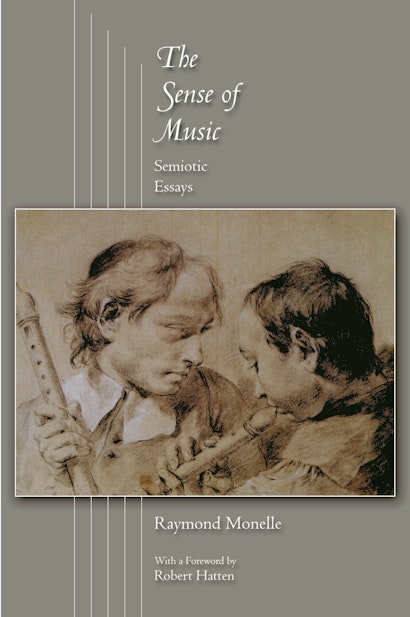
Raymond Monelle
With a foreword by Robert Hatten

Paper | 2000 | $44.00 / £29.95
336 pp. | 6 x 9 | 6 tables, 1 halftone

e-Book | 2001 | $44.00 | ISBN: 978-1-4008-2403-8

Shopping Cart | Endorsements | Table of Contents

LEARN MORE ABOUT PRINCETON'S SPECIAL SALE

Google full text of this book:


Paper $12.00
73% off regular price

For customers in the
U.S. and Canada only

The fictional Dr. Strabismus sets out to write a new comprehensive theory of music. But music's tendency to deconstruct itself combined with the complexities of postmodernism doom him to failure. This is the parable that frames The Sense of Music, a novel treatment of music theory that reinterprets the modern history of Western music in the terms of semiotics.

Based on the assumption that music cannot be described without reference to its meaning, Raymond Monelle proposes that works of the Western classical tradition be analyzed in terms of temporality, subjectivity, and topic theory. Critical of the abstract analysis of musical scores, Monelle argues that the score does not reveal music's sense. That sense--what a piece of music says and signifies--can be understood only with reference to history, culture, and the other arts. Thus, music is meaningful in that it signifies cultural temporalities and themes, from the traditional manly heroism of the hunt to military power to postmodern "polyvocality."

This theoretical innovation allows Monelle to describe how the Classical style of the eighteenth century--which he reads as a balance of lyric and progressive time--gave way to the Romantic need for emotional realism. He argues that irony and ambiguity subsequently eroded the domination of personal emotion in Western music as well as literature, killing the composer's subjectivity with that of the author. This leaves Dr. Strabismus suffering from the postmodern condition, and Raymond Monelle with an exciting, controversial new approach to understanding music and its history.

Endorsement:

"This book is an extremely significant contribution to the field. It moves considerably beyond much that has been written in music semiotics and is strikingly original."--Robert S. Hatten, author of Musical Meanings in Beethoven: Markedness, Correlation, and Interpretation

Table of Contents:

Forward by Robert S. Hatten xi
Preface xv
1. The Wordless Song 3
2. The Search for Topics 14
3. Topic and Leitmotiv 41
4. The Temporal Image 81
5. Genre and Structure 115
6. Text and Subjectivity 147
7. Mahler and Gustav 170
8. Allergory and Deconstruction 196
9. New Beginnings 227
Bibliography 233
Index 243

Subject Area:

Shopping Cart:

Paper $12.00
73% off regular price

Special online sale for customers in the U.S. & Canada only

For customers in the U.S., Canada, Latin America, Asia, and Australia

Paper: $44.00 ISBN13: 978-0-691-05716-3

For customers in Europe, Africa, the Middle East, and India

Paper: £29.95 ISBN13: 978-0-691-05716-3

Our e-Book editions are available from many of these online vendors

Prices subject to change without notice

File created: 10/18/2009

Questions and comments to: webmaster@press.princeton.edu
Princeton University Press

ONLINE BOOK SALE
New Book E-Mails
New In Print
PUP Blog
Subjects
Catalogs
Series
Sample Chapters
Podcasts/Vodcasts
Recent Awards
Google Settlement
E-Books
Online Books
Online Ordering
For Reviewers
Class Use
Permissions
About Us
Contact Us
European Office
Links
F.A.Q.
Home Page
Send me emails
about new books in:
Music
More Choices
Email:
Country:
Name: