Book Search:  


Google full text of our books:

bookjacket

Disjointed Pluralism:
Institutional Innovation and the Development of the U.S. Congress
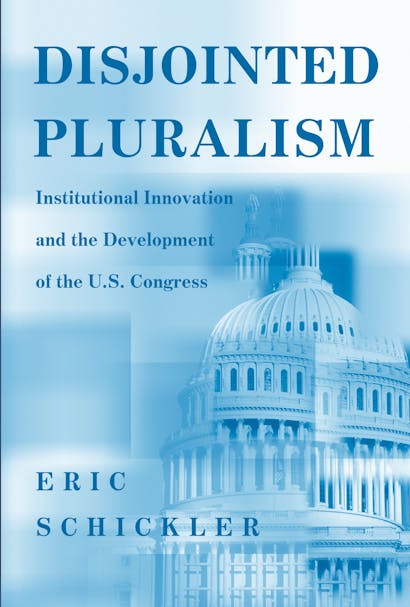
Eric Schickler

Winner of Fenno Prize.

Paper | 2001 | $38.50 / £26.95
360 pp. | 6 x 9 | 4 line illus., 19 tables

e-Book | 2001 | $38.50 | ISBN: 978-1-4008-2425-0

Shopping Cart | Reviews | Table of Contents
Chapter 1 [HTML] or [PDF]

Google full text of this book:
 

From the 1910 overthrow of "Czar" Joseph Cannon to the reforms enacted when Republicans took over the House in 1995, institutional change within the U.S. Congress has been both a product and a shaper of congressional politics. For several decades, scholars have explained this process in terms of a particular collective interest shared by members, be it partisanship, reelection worries, or policy motivations. Eric Schickler makes the case that it is actually interplay among multiple interests that determines institutional change. In the process, he explains how congressional institutions have proved remarkably adaptable and yet consistently frustrating for members and outside observers alike.

Analyzing leadership, committee, and procedural restructuring in four periods (1890-1910, 1919-1932, 1937-1952, and 1970-1989), Schickler argues that coalitions promoting a wide range of member interests drive change in both the House and Senate. He shows that multiple interests determine institutional innovation within a period; that different interests are important in different periods; and, more broadly, that changes in the salient collective interests across time do not follow a simple logical or developmental sequence. Institutional development appears disjointed, as new arrangements are layered on preexisting structures intended to serve competing interests. An epilogue assesses the rise and fall of Newt Gingrich in light of these findings.

Schickler's model of "disjointed pluralism" integrates rational choice theory with historical institutionalist approaches. It both complicates and advances efforts at theoretical synthesis by proposing a fuller, more nuanced understanding of institutional innovation--and thus of American political development and history.

Reviews:

"This is a very good read for students of Congress who puzzle over the institution's configuration. . . . An excellent examination of institutional change."--Choice

"If we know anything about the U.S. Congress it is this: Congress is a dynamic, ever-changing institution. . . . Alas, for good reasons our theories of congressional organization tend to the static and our empirical analyses tend to the cross-sectional. Eric Schickler's fine book joins a growing set of efforts to understand how and why Congress changes."--Garry Young, Political Science Quarterly

"This book is essential reading for those interested in internal legislative politics, and an important contribution to the more general literature on American politics."--Keith E. Whittington, Congress and the Presidency

Endorsements:

"This is an excellent piece of work, which will be influential. Both rational choice and developmental theorists and congressional scholars will read it. This book will be required reading for all Americanists in political science. It should win several prizes for its thoughtfulness, appropriateness, and careful, knowledgeable use of history."--David Brady, Stanford University

"This is an ambitious piece of work on an important topic. I am impressed with the exhaustive search for sources and the splendid, integrated account of so much of Congress's institutional development. It is a remarkable achievement."--Steven S. Smith, University of Minnesota

Table of Contents:

List of Figures ix
List of Tables xi
Acknowledgments xiii
Chapter 1. Disjointed Pluralism and Institutional Change 3
Chapter 2. Institutional Development, 1890-1910: An Experiment in Party Government 27
Chapter 3. Institutional Development, 1919-1932: Cross-Party Coalitions, Bloc Government, and Republican Rule 85
Chapter 4. Institutional Development, 1937-1952: The Conservative Coalition, Congress against the Executive, and Committee Government 136
Chapter 5. Institutional Development, 1970-1989: A Return to Party Government or the Triumph of Individualism? 189
Chapter 6. Understanding Congressional Change 249
Epilogue. Institutional Change in the 1990s 270
Appendix A. Case Selection 277
Appendix B. Votes Pertaining to Institutional Changes in
Each Period 281
Notes 295
References 329
Index 349

Another Princeton book by Eric Schickler:

Series:

Subject Areas:

Shopping Cart:

For customers in the U.S., Canada, Latin America, Asia, and Australia

Paper: $38.50 ISBN13: 978-0-691-04926-7

For customers in Europe, Africa, the Middle East, and India

Paper: £26.95 ISBN13: 978-0-691-04926-7

Our e-Book editions are available from many of these online vendors

Prices subject to change without notice

File created: 11/4/2009

Questions and comments to: webmaster@press.princeton.edu
Princeton University Press

ONLINE BOOK SALE
New Book E-Mails
New In Print
PUP Blog
Subjects
Catalogs
Series
Sample Chapters
Podcasts/Vodcasts
Recent Awards
Google Settlement
E-Books
Online Books
Online Ordering
For Reviewers
Class Use
Permissions
About Us
Contact Us
European Office
Links
F.A.Q.
Home Page
Send me emails
about new books in:
Political Science and International Relations
American History
More Choices
Email:
Country:
Name: