Book Search:  


Google full text of our books:

bookjacket

The Powers of Distance:
Cosmopolitanism and the Cultivation of Detachment
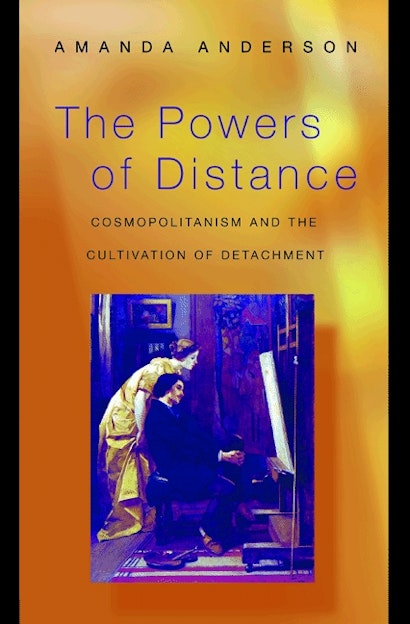
Amanda Anderson

Paper | 2001 | $24.95 / £14.95
206 pp. | 6 x 9

Shopping Cart | Reviews | Table of Contents

Google full text of this book:
 

Combining analysis of Victorian literature and culture with forceful theoretical argument, The Powers of Distance examines the progressive potential of those forms of cultivated detachment associated with Enlightenment and modern thought. Amanda Anderson explores a range of practices in nineteenth-century British culture, including methods of objectivity in social science, practices of omniscience in artistic realism, and the complex forms of affiliation in Victorian cosmopolitanism. Anderson demonstrates that many writers--including George Eliot, John Stuart Mill, Charlotte Brontë, Matthew Arnold, and Oscar Wilde--thoughtfully address the challenging moral questions that attend stances of detachment. In so doing, she offers a revisionist account of Victorian culture and a tempered defense of detachment as an ongoing practice and aspiration.

The Powers of Distance illuminates its historical object of study and provides a powerful example for its theoretical argument, showing that an ideal of critical detachment underlies the ironic modes of modernism and postmodernism as well as the tradition of Enlightenment thought and critical theory. Its broad understanding of detachment and cultivated distance, together with its focused historical analysis, will appeal to theorists and critics across the humanities, particularly those working in literary and cultural studies, feminism, and postcolonialism. Original in scope and thesis, this book constitutes a major contribution to literary history and contemporary theory.

Review:

"The Powers of Distance . . . consistently delivers the double payoff of enriched views on both Victorian texts and contemporary debates."--Victorian Studies

Endorsements:

"The Powers of Distance is an extremely important book. Of the many attractive things about it, the most attractive is the wonderful independence of thought it exhibits. Anderson frees herself to a fresh imagination of the Victorians, of contemporary critical theory, and of cosmopolitanism. The book is also a model of writing--a thoroughly polished piece of work that marks out a new direction for criticism."--George Levine

"This is an extremely well-argued and timely book. Given Anderson's already high reputation, there is probably no one among the younger generation of Victorianists whose latest offering would be as eagerly and widely awaited, and this book is going to satisfy even the most expectant. It is a major new statement about the Victorian period and about the current practice of criticism."--Bruce Robbins

Table of Contents:

Acknowledgments ix
Introduction: Forms of Detachment 3
Chapter One: Gender, Modernity, and Detachment Domestic Ideas and the Case of Charlotte Bronte's Villette 34
Chapter Two: Cosmopolitanism in Different Voices Charles Dicken's Little Dorrit and the Hermeneutics of Suspicion 63
Chapter Three: Disinterestedness as a Vocation Revisisting Matthew Arnold 91
Chapter Four: The Cultivation of Partiality George Eliot and the Jewish Question 119
Chapter Five: "Manners Before Morals" Oscar Wilde and Epigrammatic Detachment 147
Conclusion: The Character of Theory 177
Bibliography 181
Index 193

Other Princeton books by Amanda Anderson:

Subject Area:

Shopping Cart:

For customers in the U.S., Canada, Latin America, Asia, and Australia

Paper: $24.95 ISBN13: 978-0-691-07497-9

For customers in Europe, Africa, the Middle East, and India

Paper: £14.95 ISBN13: 978-0-691-07497-9

Prices subject to change without notice

File created: 7/1/2008

Questions and comments to: webmaster@press.princeton.edu
Princeton University Press

New Book E-Mails
New In Print
Subjects
Catalogs
Series
Sample Chapters
Podcasts/Vodcasts
Recent Awards
E-Books
Online Books
Online Ordering
For Reviewers
Permissions
Class Use
About Us
Contact Us
European Office
Links
F.A.Q.
Home Page
Send me emails
about new books in:
British Literature
More Choices
Email:
Country:
Name: