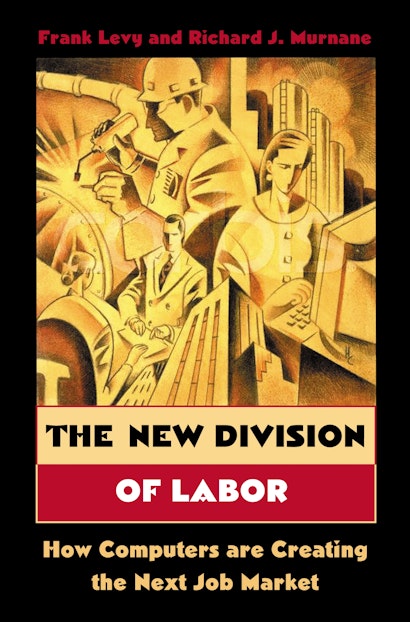
As the current recession ends, many workers will not be returning to the jobs they once held—those jobs are gone. In The New Division of Labor, Frank Levy and Richard Murnane show how computers are changing the employment landscape and how the right kinds of education can ease the transition to the new job market.
The book tells stories of people at work—a high-end financial advisor, a customer service representative, a pair of successful chefs, a cardiologist, an automotive mechanic, the author Victor Hugo, floor traders in a London financial exchange. The authors merge these stories with insights from cognitive science, computer science, and economics to show how computers are enhancing productivity in many jobs even as they eliminate other jobs—both directly and by sending work offshore. At greatest risk are jobs that can be expressed in programmable rules—blue collar, clerical, and similar work that requires moderate skills and used to pay middle-class wages. The loss of these jobs leaves a growing division between those who can and cannot earn a good living in the computerized economy. Left unchecked, the division threatens the nation’s democratic institutions.
The nation’s challenge is to recognize this division and to prepare the population for the high-wage/high-skilled jobs that are rapidly growing in number—jobs involving extensive problem solving and interpersonal communication. Using detailed examples—a second grade classroom, an IBM managerial training program, Cisco Networking Academies—the authors describe how these skills can be taught and how our adjustment to the computerized workplace can begin in earnest.
"Behind all the angst about computers and outsourcing destroying American livelihoods lies a story about economic change and its effect on workers. With welcome clarity, brevity, and insight, Levy and Murnane tell us how to make sense of the time in which we live."—David Wessel, "Capital" columnist, Wall Street Journal
"In their brilliant new book The New Division of Labor: How Computers Are Creating the Next Job Market, Frank Levy and Richard J. Murnane write that the future belongs to people who excel at expert thinking (solving problems for which there are no rules-based solutions) and complex communication (interacting with people to acquire information, understand what that information means and persuade others of its implications for action)."—ComputerWorld
"A concise and easily accessible exploration of how the computer has shifted the demands for certain types of skills. Unlike the sky-is-falling commentators of the left and the technology-will-solve-all-problems cheerleaders of the right, Levy and Murnane use history, anecdotes and statistical analysis to delineate how technology will change the nature of work."—Washington Post
"[A] fascinating book. Not since the mathematical economist Truman Bewley interviewed 300 business executives and labor leaders for Why Wages Don't Fall during a Recession have sophisticated economists waded so deeply into the real-world circumstances of the important problem they are seeking to understand."—David Warsh, economicprincipals.com
"Remember that barely one-third of New York City's eighth-graders can read and do basic math. Then, read this book."—Nicole Gelinas, New York Post
"Frank Levy and Richard J. Murnane have written a very readable introduction to some key issues facing US workers in an increasingly informational economy. . . . [R]eaders exploring these ideas for the first time will find this an engaging and provocative introduction to an important set of political-economic processes that continue to bring information technology and human labor together, for better or for worse."—Greg Downey, International Review of Social History
"A timely contribution. The New Division of Labor adds an important level of understanding to the changes we are witnessing in our labor markets. There is a message regarding the skills that are required by our economy and implications for educational reform and a message as to the political tensions that accompany this transition. The phenomenon described is of global relevance."—-John Reed, Interim Chairman of the New York Stock Exchange
"Levy and Murnane go beyond conventional accounts of the effect of automation on the workforce to take a comprehensive and thoughtful look at how increased use of technology is affecting the occupational distribution in the U.S., and precisely what skills are likely to be valued in tomorrow's labor markets. This should be read by all who care about the future of work in America."—Lawrence H. Summers, President, Harvard University
"A fascinating, important book. Levy and Murnane tackle one of the most important questions in contemporary economics, how computers change the way work is organized and how labor markets reward skill. The answer they offer is simple and powerful."—James B. Rebitzer, Case Western Reserve University
"This book, through a wealth of examples, gives the reader a concrete sense of how computers have changed the nature of the workplace."—John Bound, University of Michigan