Book Search:  


Google full text of our books:

bookjacket

Proving Woman:
Female Spirituality and Inquisitional Culture in the Later Middle Ages
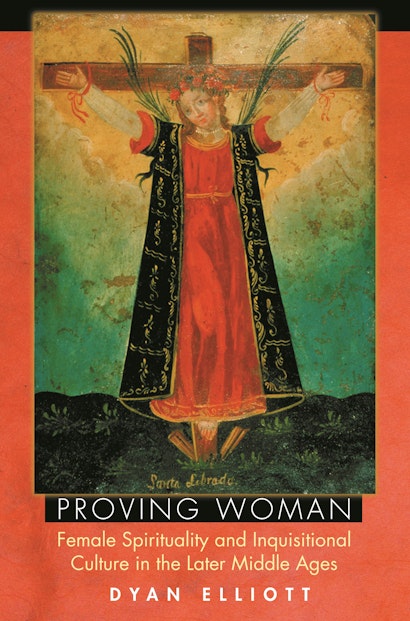
Dyan Elliott

Winner of the 2006 Otto Grundler Award, Western Michigan University, The Medieval Institute
Finalist for the 2005 Philip Schaff Prize, The American Society of Church History

Paper | 2004 | $30.95 / £18.95
368 pp. | 6 x 9

Shopping Cart | Reviews | Table of Contents
Introduction [HTML] or [PDF]

Google full text of this book:
 

Around the year 1215, female mystics and their sacramental devotion were among orthodoxy's most sophisticated weapons in the fight against heresy. Holy women's claims to be in direct communication with God placed them in positions of unprecedented influence. Yet by the end of the Middle Ages female mystics were frequently mistrusted, derided, and in danger of their lives. The witch hunts were just around the corner.

While studies of sanctity and heresy tend to be undertaken separately, Proving Woman brings these two avenues of inquiry together by associating the downward trajectory of holy women with medieval society's progressive reliance on the inquisitional procedure. Inquisition was soon used for resolving most questions of proof. It was employed for distinguishing saints and heretics; it underwrote the new emphasis on confession in both sacramental and judicial spheres; and it heralded the reintroduction of torture as a mechanism for extracting proof through confession.

As women were progressively subjected to this screening, they became ensnared in the interlocking web of proofs. No aspect of female spirituality remained untouched. Since inquisition determined the need for tangible proofs, it even may have fostered the kind of excruciating illnesses and extraordinary bodily changes associated with female spirituality. In turn, the physical suffering of holy women became tacit support for all kinds of earthly suffering, even validating temporal mechanisms of justice in their most aggressive forms. The widespread adoption of inquisitional mechanisms for assessing female spirituality eventuated in a growing confusion between the saintly and heretical and the ultimate criminalization of female religious expression.

Review:

"By revealing the importance of gender-related issues where we had not seen them, [Dyan Elliot] presents that familiar picture in a new, indeed unfamiliar, light."--John Coakley, American Historical Review

Endorsements:

"In this provocative and forceful book, Dyan Elliott considers the impact of an institutional procedure on the phenomena it was used to assess. Proving Woman examines sacramental confession, the inquisition of heretics, and the discernment of spirits as parallel cases of a growing medieval concern with the "proving" of spirituality, especially that of women, by an increasingly skeptical clergy. Elliott carefully sifts through primary sources in diverse genres, including many little-known texts, in her characteristically sharp and lucid prose."--Barbara Newman, Northwestern University

"Elliott has written a very smart book; it is complex, subtle and challenging, and an important work of scholarship."--Penelope D. Johnson, New York University

Table of Contents:

Acknowledgments ix
Abbreviations xi
Introduction 1
CHAPTER ONE
Sacramental Confession as Proof of Orthodoxy 9
PART ONE
Women as Proof of Orthodoxy
CHAPTER TWO
The Beguines: A Sponsored Emergence 47
CHAPTER THREE
Elisabeth of Hungary: Between Men 85
PART TWO
Inquisitions and Proof
CHAPTER FOUR
Sanctity, Heresy, and Inquisition 119
CHAPTER FIVE
Between Two Deaths: The Living Mystic 180
PART THREE
The Discernment of Spirits
CHAPTER SIX
Clerical Quibbles 233
CHAPTER SEVEN
John Gerson and Joan of Arc 264
CONCLUSION 297
Bibliography 305
Index 333

Subject Areas:

Shopping Cart:

For customers in the U.S., Canada, Latin America, Asia, and Australia

Paper: $30.95 ISBN13: 978-0-691-11860-4

For customers in Europe, Africa, the Middle East, and India

Paper: £18.95 ISBN13: 978-0-691-11860-4

Prices subject to change without notice

File created: 7/1/2008

Questions and comments to: webmaster@press.princeton.edu
Princeton University Press

New Book E-Mails
New In Print
Subjects
Catalogs
Series
Sample Chapters
Podcasts/Vodcasts
Recent Awards
E-Books
Online Books
Online Ordering
For Reviewers
Permissions
Class Use
About Us
Contact Us
European Office
Links
F.A.Q.
Home Page
Send me emails
about new books in:
Religion
Gender Studies
European History
More Choices
Email:
Country:
Name: