Book Search:  


Google full text of our books:

bookjacket

The Hand of Compassion:
Portraits of Moral Choice during the Holocaust
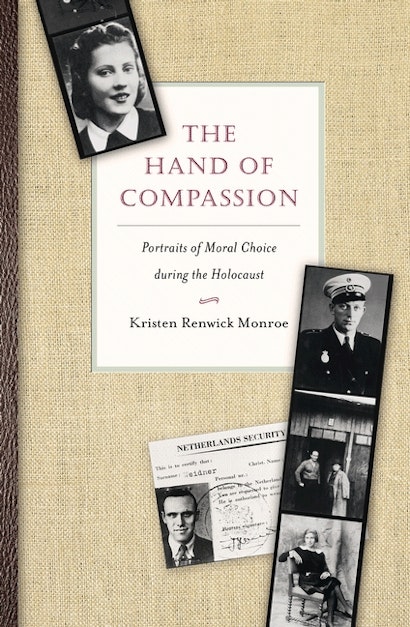
Kristen Renwick Monroe

Winner of the 2005 Robert E. Lane Award, Division of Political Psychology, American Political Science Association
Honorable Mention for the 2005 Giovanni Sartori Book Award, Qualitative Methods Section, American Political Science Association

Paper | 2006 | $28.95 / £19.95 | ISBN: 9780691127736
384 pp. | 6 x 9 | 10 halftones.

Shopping Cart | Reviews | Table of Contents
Chapter 1 [HTML] or [PDF]

Through moving interviews with five ordinary people who rescued Jews during the Holocaust, Kristen Monroe casts new light on a question at the heart of ethics: Why do people risk their lives for strangers and what drives such moral choice? Monroe's analysis points not to traditional explanations--such as religion or reason--but to identity. The rescuers' perceptions of themselves in relation to others made their extraordinary acts spontaneous and left the rescuers no choice but to act. To turn away Jews was, for them, literally unimaginable. In the words of one German Czech rescuer, "The hand of compassion was faster than the calculus of reason."

At the heart of this unusual book are interviews with the rescuers, complex human beings from all parts of the Third Reich and all walks of life: Margot, a wealthy German who saved Jews while in exile in Holland; Otto, a German living in Prague who saved more than 100 Jews and provides surprising information about the plot to kill Hitler; John, a Dutchman on the Gestapo's "Most Wanted List"; Irene, a Polish student who hid eighteen Jews in the home of the German major for whom she was keeping house; and Knud, a Danish wartime policeman who took part in the extraordinary rescue of 85 percent of his country's Jews.

We listen as the rescuers themselves tell the stories of their lives and their efforts to save Jews. Monroe's analysis of these stories draws on philosophy, ethics, and political psychology to suggest why and how identity constrains our choices, both cognitively and ethically. Her work offers a powerful counterpoint to conventional arguments about rational choice and a valuable addition to the literature on ethics and moral psychology. It is a dramatic illumination of the power of identity to shape our most basic political acts, including our treatment of others.

But always Monroe returns us to the rescuers, to their strong voices, reminding us that the Holocaust need not have happened and revealing the minds of the ethically exemplary as they negotiated the moral quicksand that was the Holocaust.

Review:

"The Hand of Compassion is a compelling and powerful read, a terrific book filled with moving narratives of risk, loss, and sadness, and at the same time, the rescuers' affirmation that all human beings deserve the right to decent treatment. It is an analysis that takes social and political theory out of the text and places the reader in the midst of human suffering and courage."--James M. Glass, Perspectives on Politics

"Approximately two-thirds of this volume is devoted to personal narratives of five rescuers, based on interviews conducted by Monroe. The autobiographies of the rescuers are substantial additions to the body of Holocaust testimony. To her credit, Monroe is an unobtrusive interviewer and a light-handed editor who allows the stories to unfold in illuminating detail."--Choice

Endorsement:

"Infrequently does one read a book that clearly stands as a major contribution to its field. Even less frequently does such a book manage to speak lucidly and intelligibly to two worlds--academia and the general public. In presenting a new theory--of identity and perspective--to help understand the actions of rescuers during the Holocaust, Professor Monroe offers us not only a compelling explanation but one that is at the same time as emotionally moving as it is intellectually persuasive. This is an extraordinary achievement."--David Easton, author of A Systems Analysis of Political Life

"Monroe's very well written argument is advanced and justified by the five individual first-person narratives, gripping in their microdetail, at the heart of this book. I couldn't put the book down."--Susanne Hoeber Rudolph, University of Chicago, author of Reversing the Gaze

More Endorsements

Table of Contents:

PREFACE ix
ACKNOWLEDGMENTS xv
Stories That Are True 1
CHAPTER ONE: Margot 9
CHAPTER TWO: Otto 55
CHAPTER THREE: John 101
CHAPTER FOUR: Irene 139
CHAPTER FIVE: Knud 165
CHAPTER SIX: The Complexity of the Moral Life and: the Power of Identity to Influence Choice 187
CHAPTER SEVEN: How Identity and Perspective Led to Moral Choice 211
CHAPTER EIGHT: What Makes People Help Others: Constructing Moral Theory 239
A Different Way of Seeing Things 257
APPENDIX A: Narratives as Windows on the Minds of Others 267
APPENDIX B: Finding the Rescuers 287
NOTES 291
BIBLIOGRAPHY 331
INDEX 355

Other Princeton books authored or coauthored by Kristen Renwick Monroe:

Subject Areas:

Shopping Cart:

For customers in the U.S., Canada, Latin America, Asia, and Australia

Paper: $28.95 ISBN: 9780691127736

For customers in Europe, Africa, the Middle East, and India

Paper: £19.95 ISBN: 9780691127736

Prices subject to change without notice

File created: 5/2/2013

Questions and comments to: webmaster@press.princeton.edu
Princeton University Press

New Book E-mails
New In Print
PUP Blog
Videos/Audios
Sample Chapters
Subjects
Series
Catalogs
eBooks
Textbooks
For Reviewers
Class Use
Rights
Permissions
Online Ordering
Recent Awards
Princeton Shorts
Freshman Reading
Princeton APPS
PUP Europe
About Us
Contact Us
Links
F.A.Q.
PUP Home


Bookmark and Share
Send me emails
about new books in:
Jewish Studies
Political Science and International Relations
Psychology
Philosophy
European History
More Choices
Email:
Country:
Name: