Barbershops, Bibles, and BET: Everyday Talk and Black Political Thought
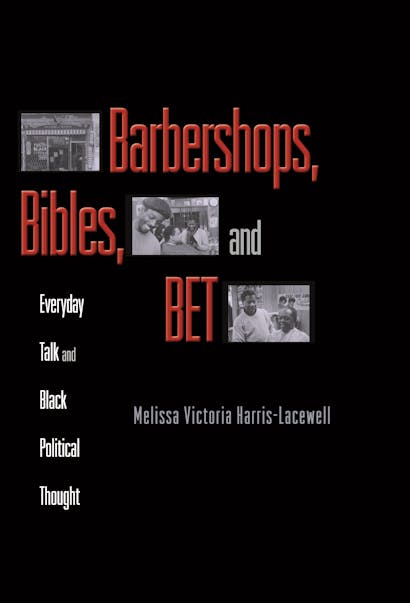
Paperback
- Price:
- $42.00/£35.00
- ISBN:
- Published:
- Jul 23, 2006
- Copyright:
- 2004
- Pages:
- 368
- Size:
- 6 x 9.25 in.
- 4 halftones. 12 line illus. 19 tables.
ebook
What is the best way to understand black political ideology? Just listen to the everyday talk that emerges in public spaces, suggests Melissa Harris-Lacewell. And listen this author has—to black college students talking about the Million Man March and welfare, to Southern, black Baptists discussing homosexuality in the church, to black men in a barbershop early on a Saturday morning, to the voices of hip-hop music and Black Entertainment Television.
Using statistical, experimental, and ethnographic methods Barbershops, Bibles, and B.E.T offers a new perspective on the way public opinion and ideologies are formed at the grassroots level. The book makes an important contribution to our understanding of black politics by shifting the focus from the influence of national elites in opinion formation to the influence of local elites and people in daily interaction with each other. Arguing that African Americans use community dialogue to jointly develop understandings of their collective political interests, Harris-Lacewell identifies four political ideologies that constitute the framework of contemporary black political thought: Black Nationalism, Black Feminism, Black Conservatism and Liberal Integrationism. These ideologies, the book posits, help African Americans to understand persistent social and economic inequality, to identify the significance of race in that inequality, and to devise strategies for overcoming it.
Awards and Recognition
- Winner of the 2005 Best Book Award in Racial and Ethnic Political Identities, Ideologies and Theories Category; Race, Ethnicity, and Politics Section of the American Political Science Association
- Co-Winner of the 2005 W.E.B. Du Bois Book Award, National Conference of Black Political Scientists