Exile, Ostracism, and Democracy: The Politics of Expulsion in Ancient Greece
Hardcover
- Price:
- $87.00/£72.00
- ISBN:
- Published:
- Oct 30, 2005
- Copyright:
- 2006
- Pages:
- 376
- Size:
- 6 x 9.25 in.
ebook
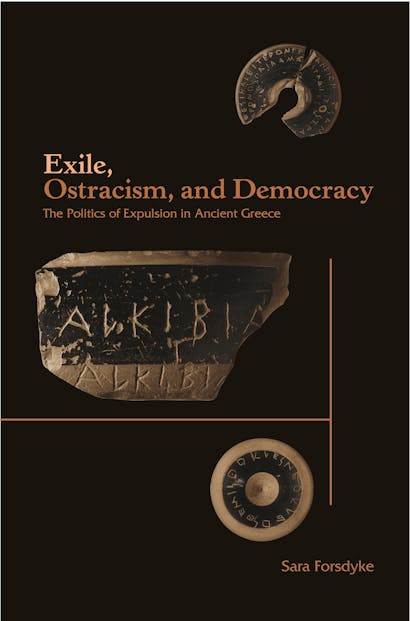
This book explores the cultural and political significance of ostracism in democratic Athens. In contrast to previous interpretations, Sara Forsdyke argues that ostracism was primarily a symbolic institution whose meaning for the Athenians was determined both by past experiences of exile and by its role as a context for the ongoing negotiation of democratic values.
The first part of the book demonstrates the strong connection between exile and political power in archaic Greece. In Athens and elsewhere, elites seized power by expelling their rivals. Violent intra-elite conflict of this sort was a highly unstable form of “politics that was only temporarily checked by various attempts at elite self-regulation. A lasting solution to the problem of exile was found only in the late sixth century during a particularly intense series of violent expulsions. At this time, the Athenian people rose up and seized simultaneously control over decisions of exile and political power. The close connection between political power and the power of expulsion explains why ostracism was a central part of the democratic reforms.
Forsdyke shows how ostracism functioned both as a symbol of democratic power and as a key term in the ideological justification of democratic rule. Crucial to the author’s interpretation is the recognition that ostracism was both a remarkably mild form of exile and one that was infrequently used. By analyzing the representation of exile in Athenian imperial decrees, in the works of Herodotus, Thucydides, Plato, Aristotle, and in tragedy and oratory, Forsdyke shows how exile served as an important term in the debate about the best form of rule.