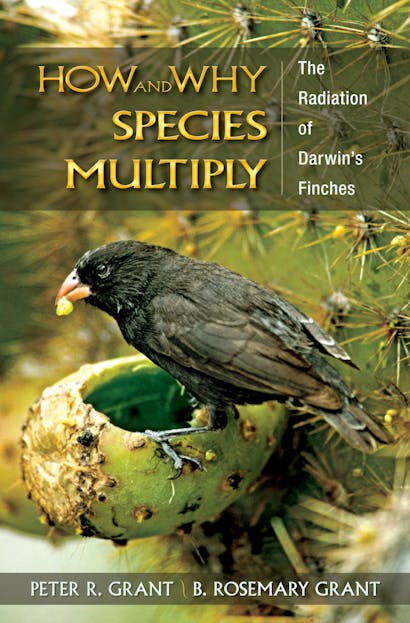
Charles Darwin’s experiences in the Galápagos Islands in 1835 helped to guide his thoughts toward a revolutionary theory: that species were not fixed but diversified from their ancestors over many generations, and that the driving mechanism of evolutionary change was natural selection. In this concise, accessible book, Peter and Rosemary Grant explain what we have learned about the origin and evolution of new species through the study of the finches made famous by that great scientist: Darwin’s finches.
Drawing upon their unique observations of finch evolution over a thirty-four-year period, the Grants trace the evolutionary history of fourteen different species from a shared ancestor three million years ago. They show how repeated cycles of speciation involved adaptive change through natural selection on beak size and shape, and divergence in songs. They explain other factors that drive finch evolution, including geographical isolation, which has kept the Galápagos relatively free of competitors and predators; climate change and an increase in the number of islands over the last three million years, which enhanced opportunities for speciation; and flexibility in the early learning of feeding skills, which helped species to exploit new food resources. Throughout, the Grants show how the laboratory tools of developmental biology and molecular genetics can be combined with observations and experiments on birds in the field to gain deeper insights into why the world is so biologically rich and diverse.
Written by two preeminent evolutionary biologists, How and Why Species Multiply helps to answer fundamental questions about evolution—in the Galápagos and throughout the world.
Awards and Recognition
- Peter and Rosemary Grant – Winners of the 2017 Royal Medal in Biology, The Royal Society
"One of the most compelling documentations of the operation of natural selection. In this book, the Grants aim to capture the key insights provided by Darwin's finches into mechanisms of adaptation and speciation generally. They succeed in making a complex topic accessible without losing the excitement inherent in tackling a difficult problem. There is enough depth to stimulate serious students of evolutionary biology, enough explanation for general readers and an approachable style that will please both."—Roger Butlin, Times Higher Education
"This Princeton-based couple presents their own accessible summary of their life's research in How and Why Species Multiply. The authors explain the scientific hypotheses involved...with admirable clarity...yet the book's real strength is not theory but data. The Grants' account makes exciting and lucid reading. Among those who should take note are doubters of 'old-fashioned' research methods who marvel at the prospects of genomics in the lab and wonder what use bird bands have in modern science."—Hanna Kokko, Science
"Distilled into 200 pages, this is the life's work of two of evolutionary biology's greatest advocates, Peter and Rosemary Grant. In this book they meld insights from geography, behaviour, ecology and genetics to paint a complex but compelling picture of the evolutionary process. [A] must-have primer for any biology student."—Henry Nicholls, New Scientist
"The authors' assertion that 'speciation is a process and not an event,' comes across clearly in this concise and accessible tale of 3 million years of finch evolution."—Science News
"The book illustrates how laboratory work, particularly in developmental biology and molecular genetics, can be combined effectively with observations and experimental work in the field."—J. S. Schwartz, emeritus, CUNY College of Staten Island, for, CHOICE
"This book presents a succinct and most readable summary of one of the most important contemporary field experiments in evolution and adaptive radiation. It should be basic reading for any biologist."—Ghillean Prance, Biologist
"[T]he book is authoritative, well prepared and edited . . . and attractive. The Grants have provide and excellent third part for the Darwin's finch trilogy, and this volume should serve admirably as a summary of the knowledge that they have accumulated."—A. Townsend Peterson, Quarterly Review of Biology
"How and Why Species Multiply is so impressive and such a stimulating read for two primary reasons, the first being the data presented throughout the work. Rarely do we have such detailed data on any natural system and the book draws great strength from this. The second reason is the commanding role given to ecological interactions in explaining the evolutionary dynamics of Darwin's finches."—Utku Perktas, Ibis
"The book is valuable as a condensed version of the huge amount of fine work the authors have done on the finches. It should be accessible to scientists and informed lay audiences alike. The theory and ecological aspects are very compelling."—Robert M. Zink, Bioscience
"I really enjoyed this book. It is a splendid introduction both to the finches and to radiation on islands. The authors' statement that 'Speciation is a process and not an event' should become one of the most famous quotes in evolutionary biology."—John A. Endler, University of California, Santa Barbara
"A brilliant synthesis. The authors have written a concise summary of current understanding of one of the classic case studies of evolutionary diversification, Darwin's finches of the Galápagos. I can think of no parallel to this work. This book will be an inspiration to students. The Grants' love of the subject and the research comes through clearly."—Jonathan B. Losos, Harvard University
"This is a book that summarizes decades of research on Darwin's finches and integrates it into a very accessible synthesis. What really distinguishes the book, of course, is the authority of the authors, who have lived with these birds for many years and have unparalleled familiarity with them. Readers will benefit enormously from the scholarship in this book."—David B. Wake, University of California, Berkeley