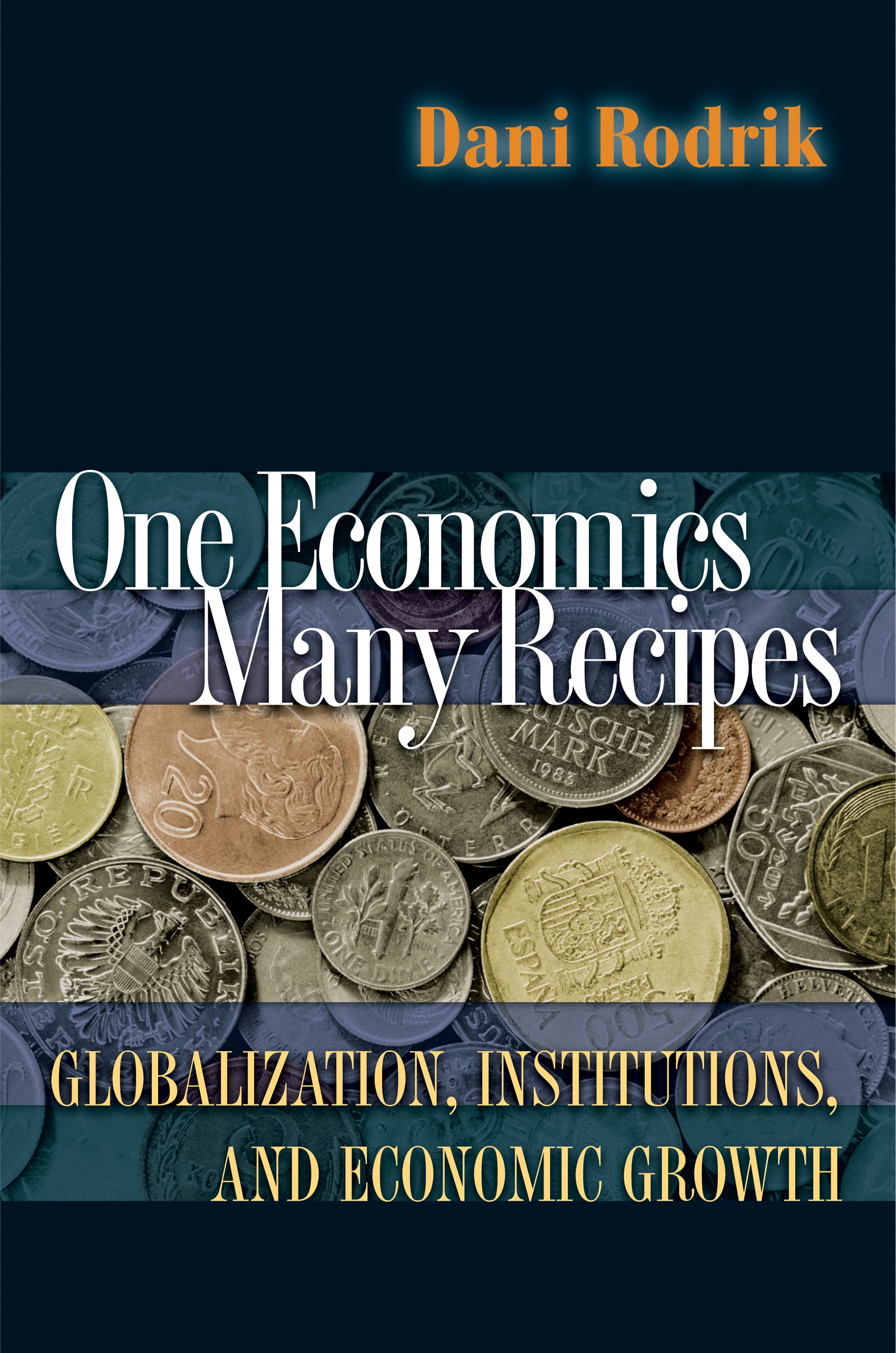
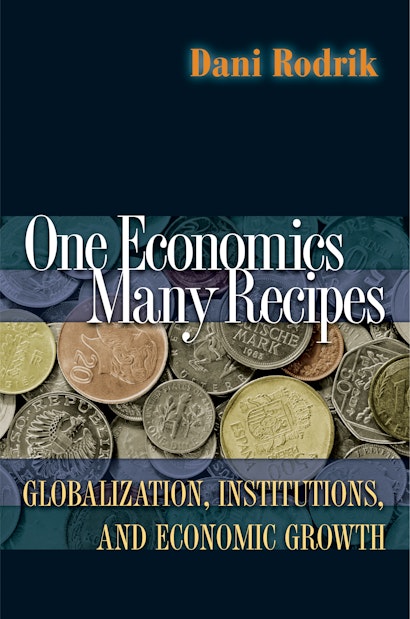
In One Economics, Many Recipes, leading economist Dani Rodrik argues that neither globalizers nor antiglobalizers have got it right. While economic globalization can be a boon for countries that are trying to dig out of poverty, success usually requires following policies that are tailored to local economic and political realities rather than obeying the dictates of the international globalization establishment. A definitive statement of Rodrik’s original and influential perspective on economic growth and globalization, One Economics, Many Recipes shows how successful countries craft their own unique strategies—and what other countries can learn from them.
To most proglobalizers, globalization is a source of economic salvation for developing nations, and to fully benefit from it nations must follow a universal set of rules designed by organizations such as the World Bank, the International Monetary Fund, and the World Trade Organization and enforced by international investors and capital markets. But to most antiglobalizers, such global rules spell nothing but trouble, and the more poor nations shield themselves from them, the better off they are. Rodrik rejects the simplifications of both sides, showing that poor countries get rich not by copying what Washington technocrats preach or what others have done, but by overcoming their own highly specific constraints. And, far from conflicting with economic science, this is exactly what good economics teaches.
"Rodrik packs a great deal into his 260 lucid, cogent pages. Orthodoxies always need serious criticism. Rodrik has supplied it. He has no simple, single recipe for remedying deficient growth—just the eminently sensible advice that there is none—there are many."—Peter Sinclair, Times Higher Education
"Dani Rodrik, a Harvard academic usually associated with the active-government side, has written an intriguing book, One Economics, Many Recipes. He argues that economists who agree who agree in general about where countries should be going can conduct open and honest—and technical rather than ideological—debates about how to get there."—Alan Beattie, Financial Times
"This book is certainly among the best of the many works on development economics recently published. . . . One Economics, Many Recipes is also a model of how applied economics should be done."—John Kay, Prospect
"The Harvard development economist Rodrik here collects a several of his recent papers into a coherent book. . . . In short, [One Economics, Many Recipes] is a critical response to the international 'consensus' approach to economic policymaking, with its implicit assumption that one set of policies is suitable in all, or at least in most, countries. Rodrik has become known for emphasizing the importance of institutions, but he here makes clear that appropriate policies are also important and that effective institutions can take many forms."—Richard Cooper, Foreign Affairs
"Rodrik's book hits many of the right buttons. He has put together a collection of essays of sufficient breadth to engage both the technical observer and the casual reader. His treatment of the subject will come as a bitter pill to both the anti-globalisation movement and the developmentariat, that international coterie of practitioners and commentators working on development issues."—Mario Pisani, New Statesman
"Rodrik is known for rigorous analysis that challenges the conventional wisdom, and this book does not disappoint. Economic growth is a very important goal, Rodrik argues, but the evidence indicates that there is no single recipe for growth."—M. Veseth, Choice
"Rodrik serves as an important, moderating voice in the globalization debate and this book proves no exception."—Sarah Cleeland Knight, Democracy and Society
"In his recent book, One Economics, Many Recipes, Harvard professor of international political economy Dani Rodrik wisely reminds us that there exists no general theory of growth, though he offers pragmatic suggestions in individual cases."—Carl J. Schramm, Claremont Review of Books
"[T]he thoughtful and scholarly elaboration of his pro-industrial policy views in this book should be essential reading for all interested in stimulating growth in these countries."—Robert E. Baldwin, World Trade Review
"Rodrik wins all hearts and minds by a careful consideration of the facts and sheer breadth of coverage. . . . Thus, market mavens, policy pros, global gurus and institutional irredentists can all savor what he says!"—Alice Amsden, EH.net
"Rodrik lays out a broad critique of prevailing approaches to development policy, offers fresh ideas for countries seeking to improve their economic performance, and argues for important reforms in the World Trade Organization (WTO) to make room for those ideas. The book is actually a collection of Rodrik's recent papers on growth, institutions, and globalization, but they constitute a remarkably coherent view of the development problem. . . . The book should have a deep and lasting effect on the way we think about economic development."—Andrés Rodríguez-Clare, Journal of International Economics
"I would highly recommend One Economics, Many Recipes to anyone interested in understanding how economics can help to improve the lives of the poor. Rodrick is innovative, challenging and extremely bright; and he has thought long and hard about this question. In addition to providing a good introduction to his own ideas, Rodrick has filtered, digested and provided his expert summary of the enormous literature on Globalization, Institutions and Economics Growth."—Emma Aisbett, Economic Record
"Dani Rodrik is a leader in applying rigorous economic analysis and informed common sense to the challenges of economic development. His knowledge, his sense of what we do and do not know, his important pointers to humility, pragmatism, and attention to context—all of these qualities permeate these excellent chapters. A book for academics and practitioners alike."—A. Michael Spence, Nobel Laureate in Economics, Stanford University
"Maybe Tolstoy was right about happy and unhappy families, but the same rule of thumb does not apply to developing economies. The success stories are not all alike. There is no practical, universal formula for rapid economic growth. That is Dani Rodrik's central argument, and he develops it forcefully and convincingly with many examples. Best of all, he insists that the need for policies tailored to local circumstances is exactly what basic economic theory suggests. He may not be right about every single thing, but I think he is right about that."—Robert M. Solow, Nobel Laureate in Economics, Massachusetts Institute of Technology
"One Economics, Many Recipes does for economic development what Julia Child did for French cooking. Child taught would-be cooks how to be excellent chefs. Dani Rodrik teaches economists and policy planners how to construct successful, sustainable development programs. He teaches and preaches the subtle correct practice of development economics."—George Akerlof, Nobel Laureate in Economics and Koshland Professor of Economics, University of California, Berkeley
"Dani Rodrik is that rare beast, both fox and hedgehog: a first-rate economist who steeps himself in politics, technology, and history to come up with striking insights and overarching principles for generating economic growth. Scholars and general readers alike will be swept along by the current of Rodrik's good-natured erudition—even those who do not share his faith in neoclassical economics. One Economics, Many Recipes is a landmark in post-Washington Consensus thinking."—Robert H. Wade, London School of Economics and Political Science, author of Governing the Market
"Dani Rodrik's One Economics, Many Recipes is a deep and important book about the relative success of nations. It considers the substance of economic policies over their superficial form. Highly successful countries have leaders who respect economic principles but keenly observe how their country differs from others and are flexible and creative in applying these principles to their own circumstances."—Robert J. Shiller, Yale University, author of Irrational Exuberance and The New Financial Order
"Although there are many articles and books on economic growth, this book is different because it proposes a new perspective that is likely to have a significant influence on academic economists as well as policymakers around the world. Dani Rodrik's new approach respects the fundamental economic principle of the market, but it also allows individual countries to formulate their own growth strategies based on their own local conditions."—Yingyi Qian, University of California, Berkeley
"In this important book, we have an author (Dani Rodrik) whose views are eminently worth hearing and a subject (globalization) in constant need of hearing them. Rodrik has long been a passionate but nuanced thinker on the role of 'economic fundamentals' in shaping growth. He resolutely uses the tools and methods of economics even as he arrives at conclusions that often do not square with what orthodox economics might prescribe or want to hear."—Michael Woolcock, the World Bank