Book Search:  

 
Google contents of this website:

 
Google full text of our books:

bookjacket

William Faulkner:
An Economy of Complex Words
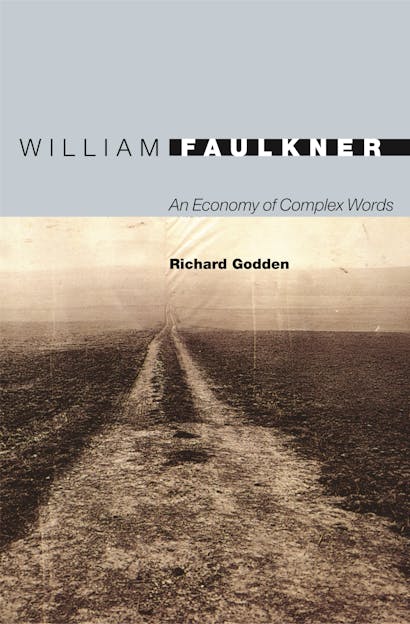
Richard Godden

Winner of the BAAS Annual Book Prize 2007

Cloth | 2007 | $39.50 / £23.95
264 pp. | 6 x 9

Shopping Cart | Endorsements | Table of Contents
Introduction [HTML] or [PDF]

Google full text of this book:
 

In William Faulkner, Richard Godden traces how the novelist's late fiction echoes the economic and racial traumas of the South's delayed modernization in the mid-twentieth century. As the New Deal rapidly accelerated the long-term shift from tenant farming to modern agriculture, many African Americans were driven from the land and forced to migrate north. At the same time, white landowners exchanged dependency on black labor for dependency on northern capital. Combining powerful close readings of The Hamlet, Go Down, Moses, and A Fable with an examination of southern economic history from the 1930s to the 1950s, Godden shows how the novels' literary complexities--from their narrative structures down to their smallest verbal emphases--reflect and refract the period's economic complexities. By demonstrating the interrelation of literary forms and economic systems, the book describes, in effect, the poetics of an economy.

Original in the way it brings together close reading and historical context, William Faulkner offers innovative interpretations of late Faulkner and makes a unique contribution to the understanding of the relation between literature and history.

Richard Godden is professor of English at the University of California, Irvine. He is the author of Fictions of Labor: William Faulkner and the South's Long Revolution and Fictions of Capital: The American Novel from James to Mailer.

Endorsements:

"Richard Godden's William Faulkner: An Economy of Complex Words is a stunning account of Faulkner's late fiction that combines intense close reading and attention to the history of mid-twentieth-century modernization to reaffirm Faulkner's centrality, not just to Southern literature or to modernist aesthetics, but to the mainstream of American history and culture."--Andrew Hoberek, University of Missouri, Columbia

"This book asks us to think again about Faulkner and the relation of language to history. It is provocative but patiently argued, theoretically sophisticated yet marvelously fluent, challenging as well as convincing. It swims against much of the current critical tide but it gets much further into new territory on Faulkner and narrative."--Richard Gray, author of The Life of William Faulkner

Table of Contents:

Acknowledgments ix
Introduction 1
CHAPTER ONE: Earthing The Hamlet 11
CHAPTER TWO: Comparative Cows: Reading The Hamlet for Its Residues 42
CHAPTER THREE: Revenants, Remnants, and Counterrevolution in "The Fire and the Hearth" 60
CHAPTER FOUR: "Pantaloon in Black" and "The Old People": Migration, Mourning, and the Exquisite Corpse of African American Labor 87
CHAPTER FIVE: Reading the Ledgers: Textual Variants and Labor Variables (with Noel Polk) 119
CHAPTER SIX: Find the Jew: Modernity, Seriality, and Armaments in A Fable 156
CHAPTER SEVEN: "The Bugger's a Jew": A Fable as Melancholic Allegory 179
Notes 203
Index 235

Series:

  • 20/21
    Walter Benn Michaels, Series Editor

Subject Areas:

Shopping Cart:

For customers in the U.S., Canada, Latin America, Asia, and Australia

Cloth: $39.50 ISBN13: 978-0-691-13071-2

For customers in Europe, Africa, the Middle East, and India

Cloth: £23.95 ISBN13: 978-0-691-13071-2

Prices subject to change without notice

File created: 4/23/2008

Questions and comments to: webmaster@press.princeton.edu
Princeton University Press

New Book E-Mails
New In Print
Subjects
Catalogs
Series
Sample Chapters
Author Interviews
Recent Awards
E-Books
Online Books
Online Ordering
For Reviewers
Permissions
Class Use
About Us
Contact Us
European Office
Links
F.A.Q.
Home Page
Send me emails
about new books in:
American Language and Literature
Comparative Literature
More Choices
Email:
Country:
Name: