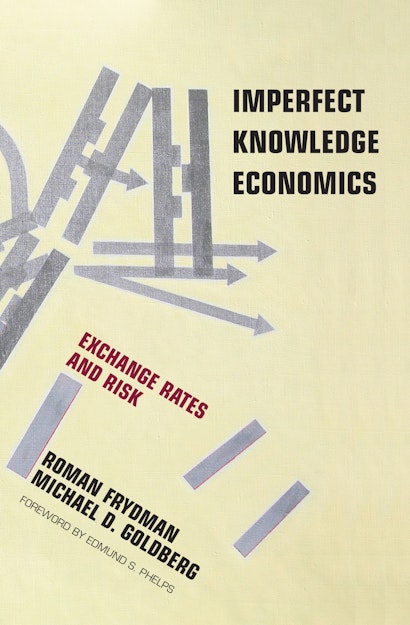
Posing a major challenge to economic orthodoxy, Imperfect Knowledge Economics asserts that exact models of purposeful human behavior are beyond the reach of economic analysis. Roman Frydman and Michael Goldberg argue that the longstanding empirical failures of conventional economic models stem from their futile efforts to make exact predictions about the consequences of rational, self-interested behavior. Such predictions, based on mechanistic models of human behavior, disregard the importance of individual creativity and unforeseeable sociopolitical change. Scientific though these explanations may appear, they usually fail to predict how markets behave. And, the authors contend, recent behavioral models of the market are no less mechanistic than their conventional counterparts: they aim to generate exact predictions of “irrational” human behavior.
Frydman and Goldberg offer a long-overdue response to the shortcomings of conventional economic models. Drawing attention to the inherent limits of economists’ knowledge, they introduce a new approach to economic analysis: Imperfect Knowledge Economics (IKE). IKE rejects exact quantitative predictions of individual decisions and market outcomes in favor of mathematical models that generate only qualitative predictions of economic change. Using the foreign exchange market as a testing ground for IKE, this book sheds new light on exchange-rate and risk-premium movements, which have confounded conventional models for decades.
Offering a fresh way to think about markets and representing a potential turning point in economics, Imperfect Knowledge Economics will be essential reading for economists, policymakers, and professional investors.
"[T]he challenge that existing economic orthodoxy may find most disconcerting is Imperfect Knowledge Economics (IKE), the name of a path-breaking recent book."—Anatole Kaletsky, The Times
". . . sets out an alternative approach to prediction, in which the forecaster recognizes that his model will inevitably be less than perfect."—The Economist
"A new book ... coins the phrase "imperfect knowledge economics" to describe this world of fundamental uncertainty."—Finanical Times
"A new conceptual framework—Imperfect Knowledge Economics (IKE)—provides the rationale for policy intervention in asset markets, and also has important implications for how regulators should measure and manage systemic financial risk."—Edmund Phelps, Guardian.co.uk
"This marvelous book by Frydman and Goldberg documents . . . invaluable insights of the 'early modern' theory of capitalism that were lost when the profession endorsed rational expectations equilibrium. . . . Happily for me and, I believe, for the profession of economics, this deeply original and important book gives signs of bringing us back on track—on a road toward an economics possessing a genuine microfoundation and at the same time a capacity to illuminate some of the many aspects of the modern economy that the rational expectations approach cannot by its nature explain."—from the foreword by Edmund S. Phelps, winner of the 2006 Nobel Prize in economics
"Anyone who has ever studied markets for financial assets such as currencies knows that it is very difficult to explain, much less predict, short to medium term fluctuations. In their innovative new work, Imperfect Knowledge Economics, Roman Frydman and Michael Goldberg make a strong case that it would be particularly helpful to improve our understanding of how financial markets process new knowledge and information. In addition, the book offers a useful guide to understanding existing empirical exchange rate models."—Kenneth Rogoff, Harvard University
"The centrality of expectations in understanding economic fluctuations has long been recognized, but their formation has not been adequately described. The rational expectation hypothesis was a bold and ingenious attempt, but it has proved empirically very far from satisfactory, most strikingly, in the field of foreign exchange markets, where the good documentation makes the failure easier to establish. Frydman and Goldberg open new doors by a more realistic understanding of the process of forming expectations; by recognizing that universal rules are intrinsically impossible, they exhibit a more creative understanding of the recent history of foreign exchange spot and futures markets."—Kenneth J. Arrow, Nobel Prize-winning economist
"If you are looking for a way to escape from the Procrustean bed of rational expectations equilibrium—and, if you pay attention to real-world data, you should be—try reading this imaginative and intelligent book. It will amply repay your efforts."—Alan S. Blinder, Princeton University
"If you have been puzzled by the difficulty of reconciling uncertainty with the equilibrium models that economists use to explain market outcomes, this is the right book to read and reread. It launches a new approach, Imperfect Knowledge Economics, which highlights the long-recognized failure of prespecified general equilibrium modeling to account for the behavior of agents under changing conditions. Frydman and Goldberg are thus proposing models that are able to generate robust qualitative predictions, leading to a better understanding of short- and long-term swings in economic variables. In macroeconomics, there will undoubtedly be a 'before' and 'after' this book."—Jean-Paul Fitoussi, president, l'Observatoire français des conjonctures économiques, Paris
"The record of contemporary economics in explaining the behavior of exchange rates is a sorry one. Frydman and Goldberg make the foreign exchange rate problem the particular object of a searching critique of current macroeconomics and use it also as the vehicle for demonstrating how they would break its methodological 'stranglehold.' Their own alternative, imperfect knowledge economics, is systematically worked out and persuasively argued. It is my hope that the book will be widely read and debated."—Axel Leijonhufvud, UCLA and the University of Trento
"This is a major and controversial contribution to macroeconomics that cannot fail to make an impact in several areas. Academics will read it for the comprehensive critique of much macroeconomic theory. More empirically motivated economists will look carefully at the rich scope for empirical analysis that the book opens up. Policymakers too will want to look at it—and will be relieved to see that they come off much better than the main authors of the rational expectations school."—Niels Thygesen, University of Copenhagen