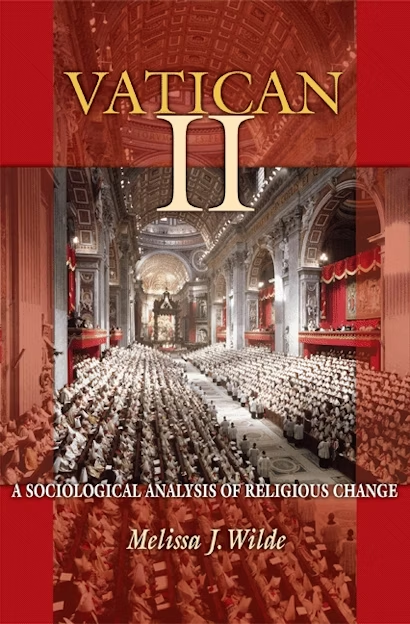
On an otherwise ordinary Sunday morning in 1964, millions of Roman Catholics around the world experienced history. For the first time in centuries, they attended masses that were conducted mostly in their native tongues. This occasion marked only the first of many profound changes to emanate from the Second Vatican Council (1962-1965). Known popularly as Vatican II, it would soon give rise to the most far-reaching religious transformation since the Reformation.
In this groundbreaking work of cultural and historical sociology, Melissa Wilde offers a new explanation for this revolutionary transformation of the Church. Drawing on newly available sources—including a collection of interviews with the Council’s key bishops and cardinals, and primary documents from the Vatican Secret Archive that have never before been seen by researchers—Wilde demonstrates that the pronouncements of the Council were not merely reflections of papal will, but the product of a dramatic confrontation between progressives and conservatives that began during the first days of the Council. The outcome of this confrontation was determined by a number of factors: the Church’s decline in Latin America; its competition and dialogue with other faiths, particularly Protestantism, in northern Europe and North America; and progressive clerics’ deep belief in the holiness of compromise and their penchant for consensus building.
Wilde’s account will fascinate not only those interested in Vatican II but anyone who wants to understand the social underpinnings of religious change.
Awards and Recognition
- Honorable Mention for the 2009 Distinguished Book Award, Sociology of Religion Section of the American Sociological Association
- Winner of the 2008 Distinguished Book Award, Society for the Scientific Study of Religion
"Wilde's innovative methodology has thrown up some extremely interesting ideas. You may not like how she reached her conclusions, but the conclusions themselves are often and fascinating and, for the most part, entirely credible...Wilde offers similar analyses of different sectors of the episcopate—southern European, Latin America, Asian and African—and they add up to an impressive account of the council's convoluted proceedings and machinations. It's often said that Vatican II never pleased anyone completely, but this book makes it abundantly clear that it was energized by what Emile Durkheim, quoted by Wilde, termed a 'collective effervescence'."—Jonathan Wright, Catholic Herald
"Vatican II is a historical treasure trove. It breaks new ground in dealing with theories of religious change in institutions, and it answers some key questions about the dynamics of the council... Very few sociological studies rival Wilde's big picture analysis of huge institutional religious change. Though Vatican II is theory-laden, Wilde writes in an accessible and jargon-free fashion to help us see what was at stake and how good organization makes a difference."—John A. Coleman, America
"Melissa Wilde provides a useful narrative of events, stressing how early victories by the progressives created a snowball of anticipation and confidence...She also provides interesting detail...[T]his book is an impressive first essay by a young and innovative scholar."—David Martin, The Tablet
"This is an insightful review of the human and spiritual dynamics surrounding the great modern council within Catholicism...Wilde brilliantly examines the possible reasons Vatican II became the most radical ecclesial and cultural phenomenon of the 20th century. Drawing on interviews, secret documents and diaries, and contemporary sociological scholarship, she clearly articulates the dynamic tension between progressives and conservatives and the resulting documents with their profound impact on modern society. This analysis grants the reader a privileged glimpse into the personalities and perspectives of ordinary bishops engaged in extraordinary work."—John-Leonard Berg, Library Journal
"Vatican II is destined to be widely read and frequently cited in both church and academic circles."—James D. Davidson, American Catholic Studies
"Wilde's work constitutes a great contribution not only to the sociology of religion, but to our understanding of how religious structures in general are not explainable by arbitrary command, but vibrant, social movement."—Myles Werntz, Religious Studies Review
"This book is the result of meticulous research on hitherto inaccessible sources. It demonstrates how legitimacy concerns are central to most organizational processes in religious institutions. . . . Princeton University Press is to be congratulated for promoting significant new research in contemporary ecclesiastical issues."—Graham Duncan, Studia Historiae Ecclesiasticae
"Melissa Wilde's Vatican II: A Sociological Analysis of Religious Change, which offers a clear and compelling account of why the world's largest religious tradition, Roman Catholicism, changed course on some key political and liturgical matters in the 1960s, represents one important effort to critique the new paradigm."—W. Bradford Wilcox, American Journal of Sociology
"I find Vatican II to be a path-breaking work, one that will influence the field of the sociology of religion for many years to come. Historians, too, will appreciate the chance to get inside the workings of a usually opaque process, whose controversies reverberate to the present day. I urge scholars from both disciplines—and interested Church officials and laity as well—to avail themselves of the opportunity."—Patricia Wittberg, Church History
"This study is a valuable addition to any student's understanding of the Council, and should be in every college, university, and seminary library with holdings in the study of the Council. It would also be a good addition to larger parish collections, especially in those with a lively interest in the Council. It is easy to downplay the importance of the Council, or to ascribe simplistic reasoning to the profound results of the Council. But Dr. Wilde has shown the complexity of how those results came about in her areas of study, and what could have been a dry, academic study has been brought to life."—Cecil R. White, Catholic Library World
"Wilde has accomplished a monumental task by taking on theoretical insufficiencies of supply-side and organizational field hypotheses, by mining thoughtfully and carefully an enormous volume of qualitative data, and by bringing cultural arguments to the fore in explaining change in organizations through analysis of the Catholic Church."—Katherine Meyer, Society for the Scientific Study of Religion
"Wilde's account will fascinate not only those interested in Vatican II but anyone who wants to understand the social underpinnings of religious change."—World Book Industry
"Wilde has written the first serious sociological study of the dynamics of the Second Vatican Council. The men who organized the 'progressive' faction were not, as is often claimed, theologians who were manipulating bishops, but bishops from the countries where the church was engaged with modernity, especially from South America. Nor did they view their efforts as anything less than a dramatic change from the past. They were great men who accomplished great deeds. After this book, no one will be able to dismiss them."—Andrew Greeley, author of The Catholic Revolution
"Wilde's big-picture analysis of huge institutional religious change exemplifies a kind of scholarship that is so valuable yet all too rare in contemporary sociology of religion. Ambitious, creative, careful, and fascinating, Vatican II makes a major contribution."—Christian Smith, University of Notre Dame
"Using a fascinating array of archival materials, Melissa Wilde here presents an innovative, behind-the-scenes, and groundbreaking analysis of the deliberations of Vatican II. And, importantly, she employs vital concepts from diverse areas of sociology to make sense of the rich empirical data at her disposal."—Michele Dillon, author of Catholic Identity: Balancing Reason, Faith, and Power
"This exciting book is poised to make a big splash in scholarly circles and beyond. Advancing a clear conceptual framework, it is unique in looking at Catholicism through the lens of the diverse national environments that affect the interests and organizational behavior of religious leaders."—Peter McDonough, author of Men Astutely Trained: A History of the Jesuits in the American Century