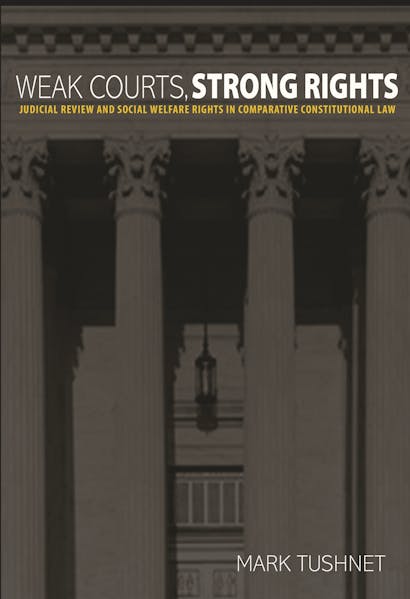
Unlike many other countries, the United States has few constitutional guarantees of social welfare rights such as income, housing, or healthcare. In part this is because many Americans believe that the courts cannot possibly enforce such guarantees. However, recent innovations in constitutional design in other countries suggest that such rights can be judicially enforced—not by increasing the power of the courts but by decreasing it. In Weak Courts, Strong Rights, Mark Tushnet uses a comparative legal perspective to show how creating weaker forms of judicial review may actually allow for stronger social welfare rights under American constitutional law.
Under “strong-form” judicial review, as in the United States, judicial interpretations of the constitution are binding on other branches of government. In contrast, “weak-form” review allows the legislature and executive to reject constitutional rulings by the judiciary—as long as they do so publicly. Tushnet describes how weak-form review works in Great Britain and Canada and discusses the extent to which legislatures can be expected to enforce constitutional norms on their own. With that background, he turns to social welfare rights, explaining the connection between the “state action” or “horizontal effect” doctrine and the enforcement of social welfare rights. Tushnet then draws together the analysis of weak-form review and that of social welfare rights, explaining how weak-form review could be used to enforce those rights. He demonstrates that there is a clear judicial path—not an insurmountable judicial hurdle—to better enforcement of constitutional social welfare rights.
Mark Tushnet is the William Nelson Cromwell Professor of Law at Harvard Law School. His many books include The New Constitutional Order and Taking the Constitution Away from the Courts (both Princeton). He is a fellow of the American Academy of Arts and Sciences.
"In this study of various theoretical issues of concern to students of comparative constitutional law, Tushnet has done a remarkable job of analyszing and comparing existing forms of judicial review....Tushnet's impeccable research leads us through varied constitutional systems including, for example, Argentina, Canada, Great Britain, and Ireland. This is constitutional scholarship at its best."—R.J. Steamer, Choice
"Tushnet explores two prominent questions that constitutional drafters must ask: What powers of judicial review should courts have? and What rights should be enumerated? . . . Tushnet's ambitious agenda in Weak Courts, Strong Rights is equally important for political scientists and comparative legal scholars."—Theresa J. Squatrito, Comparative Political Studies
"Mark Tushnet has written an important book, featuring mastery of pertinent comparative constitutional law literature and an incredible ideas-per-ink ratio. . . . Any serious scholar of comparative constitutional law cannot afford to skip this book."—Ran Hirschl, Ottawa Law Review
"Tushnet puts flesh on the bones of the claim that constitutionally guaranteed social rights, judicially enforced, are already a part of the jurisprudence of the United States and other countries of interest. He takes this argument some distance beyond where any other scholar has taken it, so far as I know, and he does so with considerable refinement. This book gives a full and strong manifestation of the style, intelligence, and learning that have earned Tushnet his eminence as a scholar of American constitutional law and comparative constitutionalism."—Frank I. Michelman, Harvard Law School
"This is an important contribution to an important debate in the United States about the possibility and prospects for the courts to play a more modest role in politics and policy. Tushnet demonstrates that, by a nice twist, a more modest judicial role could lead to a more robust set of social rights. And his comparative cases show that this is not purely theoretical, but that it has worked out to some degree in other systems."—Gordon Silverstein, University of California, Berkeley