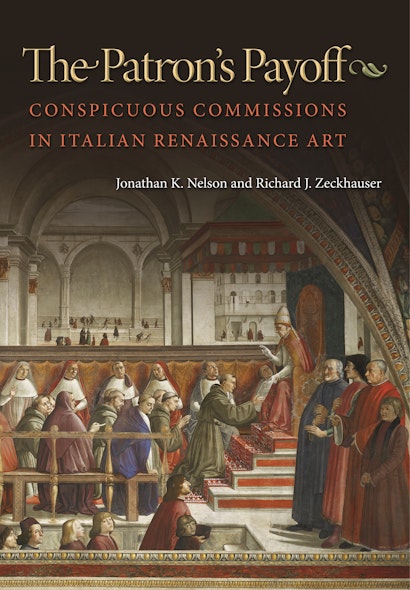
In The Patron’s Payoff, Jonathan Nelson and Richard Zeckhauser apply the innovative methods of information economics to the study of art. Their findings, written in highly accessible prose, are surprising and important. Building on three economic concepts—signaling, signposting, and stretching—the book develops the first systematic methodology for assessing the meaning of art patronage and provides a broad and useful framework for understanding how works of art functioned in Renaissance Italy.
The authors discuss how patrons used conspicuous commissions to establish and signal their wealth and status, and the book explores the impact that individual works had on society. The ways in which artists met their patrons’ needs for self-promotion dramatically affected the nature and appearance of paintings, sculptures, and buildings. The Patron’s Payoff presents a new conceptual structure that allows readers to explore the relationships among the main players in the commissioning game—patrons, artists, and audiences—and to understand how commissioned art transmits information. This book facilitates comparisons of art from different periods and shows the interplay of artists and patrons working to produce mutual benefits subject to an array of limiting factors. The authors engage several art historians to look at what economic models reveal about the material culture of Italy, ca. 1300�1600, and beyond. Their case studies address such topics as private chapels and their decorations, donor portraits, and private palaces.
In addition to the authors, the contributors are Molly Bourne, Kelley Helmstutler Di Dio, Thomas J. Loughman, and Larry Silver.
Awards and Recognition
- One of Choice's Outstanding Academic Titles for 2009
"[E]nlightening."—Times Literary Supplement
"But the basic point of this book—that a careful study of economic and related social needs can help us further understand the genesis of many works of visual culture—is undeniable, and the editors' and authors' cogent presentation of the possibilities inherent in their approach is masterful. Recognizing the motivations of elites expands our understanding of the roles that visual works could play during the period we now identify as the Italian Renaissance. As a reviewer I congratulate Nelson and Zeckhauser, while continuing to lament art history's inability—in the Renaissance at least—to gain access to a broader understanding of the diverse society and complex and subtle culture that supported the production of these works."—David G. Wilkins, CAA Reviews
"In The Patron's Payoff, art historian Jonathan K. Nelson and economist Richard J. Zeckhauser have harnessed their separate disciplines into a new analytical key for understanding the linked motivations of patron and artist or architect in conspicuous commissions. . . . No less than the American financier who donates a museum wing on condition it bears his name, or the merchandiser who endows a university institute named for him, the results of Renaissance patronage had to be, first of all, highly visible."—Judith Harris, California Literary Review
"Nelson and Zeckhauser offer historians of art and culture a powerful method for appraising the driving force behind works of art commissioned in the Renaissance. . . . The Patron's Payoff offers and innovative and potent tool for probing how works of art functioned in Renaissance social life."—Michelle O'Malley, Renaissance Quarterly
"The book's interdisciplinary approach provides a blueprint for others who might test these concepts with patrons and periods necessarily omitted from this study. Common language and readable prose illuminate the theory and animate the relationships between works of art, patrons, artists, and audience. This book will be useful to art historians, cultural historians, economists, and others interested in the significance of the production and consumption of elite culture."—D.N. Dow, Choice
"These are all well-written, interesting, well-researched essays, varying in chronological range and in geographical focus."—Bernadine Barnes, EH.net
"[T]his volume is a model of how cross-disciplinary interaction can enrich the understanding of practitioners in two participating disciplines."—Neil De Marchi, Journal of Economic Literature
"The Patron's Payoff is impressive not only for its innovative interdisciplinary approach and the compilation of an extensive source material . . . the reading [is] very entertaining, and clearly shows that even high-profile science can be attractive and intelligible."—Mila Horky, Sehepunkte
"[This] book [is] an innovative examination of art, economics, and communication that should be required reading for all who admire Italy's grand masterpieces as well as those who have made the study of Renaissance art and architecture a profession."—Fredrika Jacobs, European Legacy
"One hopes that information economists will gain as much as art historians can from this book."—Sally Hickson, Renaissance and Reformation
"If the idea appeals to you, of going back in time to the extraordinary period of the Renaissance in Italy with the patrons and the artists . . . to understand the incentives and the constraints, the opportunities and the missteps, then you must give this book a try. For me reading the book felt similar to visiting a great art museum in the company of a knowledgeable, insightful, and engaging curator: a thoroughly rewarding experience."—from the foreword by Michael Spence, 2001 Nobel laureate in economics
"Nelson and Zeckhauser have written a pathbreaking study on the role of artistic and architectural commissions in Renaissance Florence which, by its new and sophisticated methodology, employing game theory used in modern economics and political science, presents a model for similar studies of patronage in every era. Their analysis of the commissioning game is a must read for anyone interested in the hows and whys of artistic patronage during an era particularly sensitive to the possibilities presented by conspicuous consumption."—James Cuno, president and director, Art Institute of Chicago
"This genial and imaginative collaboration of art history and economic theory offers a genuinely original perspective on the commissioning game, and employs the economics of information to evaluate the patron's payoff."—Dale Kent, University of California, Riverside
"The Patron's Payoff is an innovative study of the messages artworks in Renaissance Italy tacitly communicated about the men and women who commissioned them. Nelson and Zeckhauser make a compelling case that the currency of the payoff for patrons embraced such critical social values as honor, status, family alliance, and friendship. Building their analysis upon recent economic theories, the authors offer a suggestive model for research in Renaissance studies and beyond."—Louis A. Waldman, Villa I Tatti—The Harvard Center for Italian Renaissance Studies
"A stimulating and challenging work, The Patron's Payoff offers a plausible new approach to artistic creation that has the benefit of a known set of economic tools and results. An interesting marriage between art historical and economics perspectives."—William N. Goetzmann, Yale University
"In applying a distinctive economic theory to the area of Renaissance patronage, this book fosters an interdisciplinary approach to the study of early modern European art."—Adrian Randolph, Dartmouth College