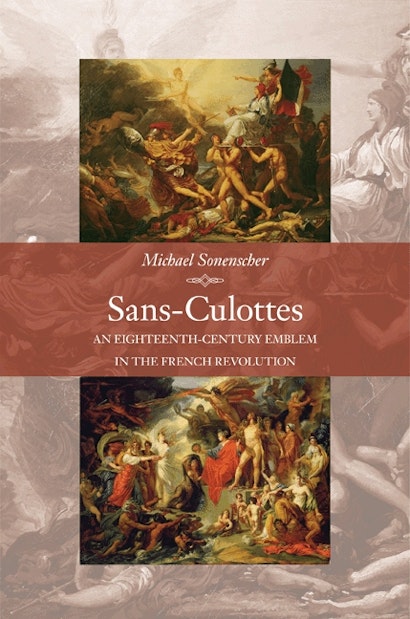
This is a bold new history of the sans-culottes and the part they played in the French Revolution. It tells for the first time the real story of the name now usually associated with urban violence and popular politics during the revolutionary period. By doing so, it also shows how the politics and economics of the revolution can be combined to form a genuinely historical narrative of its content and course. To explain how an early eighteenth-century salon society joke about breeches and urbanity was transformed into a republican emblem, Sans-Culottes examines contemporary debates about Ciceronian, Cynic, and Cartesian moral philosophy, as well as subjects ranging from music and the origins of government to property and the nature of the human soul. By piecing together this now forgotten story, Michael Sonenscher opens up new perspectives on the Enlightenment, eighteenth-century moral and political philosophy, the thought of Jean-Jacques Rousseau, and the political history of the French Revolution itself.
"This is intellectual history as free jazz. Sonenscher rips and riffs through the links to be made between all manner of ideas across several generations of salon conversation and erudite writing. . . . This work's contribution . . . to illuminating the complexity of eighteenth-century French intellectual history cannot be gainsaid."—David Andress, Times Literary Supplement
"Close attention to his text will be repaid with a deepened awareness of the variety and power of the political writing in circulation in the late monarchy. He succeeds completely in establishing that political life was in most respects richer and more full of nuance than we might imagine."—James Livesey, American Historical Review
"Sans-Culottes is a challenging read, not least because of its style and structure. Sonenscher juggles a dizzying array of primary sources. . . . That said, the payoffs to reading this book are tremendous."—Charles Walton, H-France Forum
"Sonenscher is brilliant. . . . He is equally path-breaking. . . . Sonenscher provides the most convincing account of the nature of the ideological divisions of 1789–91. . . . In providing an overview . . . Sonenscher shows what has been missed by historians of the French Revolution."—Richard Whatmore, Reviews in History
"Sonenscher's insights into the moral and economic history of prerevolutionary France are wide ranging and extremely well documented; few can rival his breadth."—Julia V. Douthwaite, Eighteenth-Century Studies
"As someone who has transformed himself during this period from a distinguished social historian to a leading expert on eighteenth century political thought, Sonenscher's professional career mirrors the trajectory scholarship of the Revolution has taken in his lifetime. . . . [T]he new book is the result of twenty-five years' patient advancing of what it is possible to know about the French Revolution and, at its heart, the elusive sans-culottes."—Ruth Scurr, Modern Intellectual History
"[T]he author succeeds in forcing the reader outside the comfort zone of more traditional approaches in an intellectual tour de force that no historian of the Revolution can safely ignore."—Hugh Gough, Historian
"Sonenscher's opera magna constitute an enormous achievement. Revealing a new face of eighteenth-century intellectual history and recovering a myriad of forgotten works, they are sure to be read—indeed to be used as references—for years to come."—Carolina Armenteros, French History
"With deftness, wit, and great erudition, Michael Sonenscher traces the complex and unexpected pre-Jacobin history of the phrase 'sans culottes' to its origins in the rivalries and concerns of the Parisian salons. This probing history brings to life the patronesses, philosophers, wits, and hacks of the ancien régime and illuminates the contending uses of ancient philosophy and visions of society and personal virtue that circulated among them. The analyses of competing Ciceronian and Cynical views of fashion, and of the gulfs between Rousseau and his self-designated acolytes, are particularly powerful. This book will be sure to transform irrevocably our understanding of the notorious emblem of Jacobinism."—Jennifer Pitts, author of A Turn to Empire
"With this book, Michael Sonenscher establishes himself as one of the most significant authors in the world today writing on the French Revolution. Focusing at the outset on the apparently unpromising question of how the revolutionary sans-culottes got their name, Sonenscher takes his readers on an extraordinary journey of discovery to the heart of the French Enlightenment and revolutionary politics. A brilliant tour de force, based on a dazzling command of eighteenth-century political and economic writing and razor-sharp analytical skills, this book will be required reading for any scholar or student interested in the origins and outcomes of the revolution."—Colin Jones, Queen Mary, University of London
"A pathbreaking account of the emergence of the concept of republican citizenship in the eighteenth century, Michael Sonenscher's Sans-Culottes is also one of the most ambitious, original, and satisfying accounts of the eighteenth-century resonance of Rousseau's arguments regarding human nature, culture, and politics that I have encountered."—E. J. Hundert, professor emeritus of history, University of British Columbia
"Drawing on a dazzling array of texts—from the most well known to the totally arcane—Michael Sonenscher reveals that the sans-culottes of revolutionary France were the cultural offspring of a deep and densely argued eighteenth-century philosophical divide. The story is utterly fascinating and will come as a surprise, especially to social historians. There are few scholars working today who can rival the breadth or depth of Sonenscher's command of eighteenth-century European intellectual culture."—Carla Hesse, University of California, Berkeley