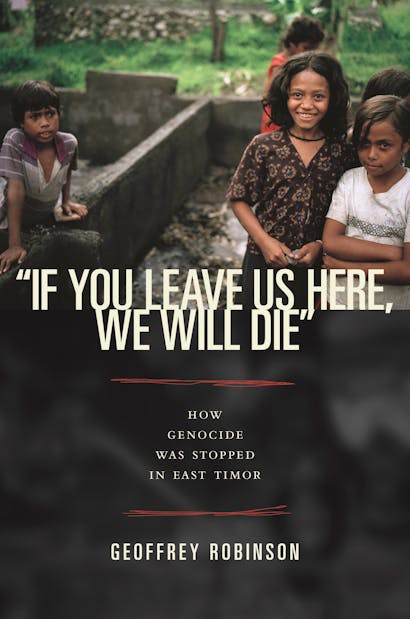
This is a book about a terrible spate of mass violence. It is also about a rare success in bringing such violence to an end. “If You Leave Us Here, We Will Die” tells the story of East Timor, a half-island that suffered genocide after Indonesia invaded in 1975, and which was again laid to waste after the population voted for independence from Indonesia in 1999. Before international forces intervened, more than half the population had been displaced and 1,500 people killed. Geoffrey Robinson, an expert in Southeast Asian history, was in East Timor with the United Nations in 1999 and provides a gripping first-person account of the violence, as well as a rigorous assessment of the politics and history behind it.
Robinson debunks claims that the militias committing the violence in East Timor acted spontaneously, attributing their actions instead to the calculation of Indonesian leaders, and to a “culture of terror” within the Indonesian army. He argues that major powers—notably the United States, Australia, and the United Kingdom—were complicit in the genocide of the late 1970s and the violence of 1999. At the same time, Robinson stresses that armed intervention supported by those powers in late 1999 was vital in averting a second genocide. Advocating accountability, the book chronicles the failure to bring those responsible for the violence to justice.
A riveting narrative filled with personal observations, documentary evidence, and eyewitness accounts, “If You Leave Us Here, We Will Die” engages essential questions about political violence, international humanitarian intervention, genocide, and transitional justice.
"Intimate, informed . . . the author offers rare insight into the country's internal turmoil. Particularly riveting are Robinson's descriptions of the days preceding the historic vote to separate from Indonesia. . . . Despite the overwhelming brutality of the story, and a bleak assessment of actions from the UN and international community (as much a part of the problem as the solution), Robinson manages to cap his detailed report with a hopeful note."—Publishers Weekly
"Robinson's book is thus a valuable addition to the literature on genocide and intervention. . . . [He] has fused his own observations from that harrowing time with a more general history of East Timor to produce a thoughtful and intelligent volume."—Richard Just, New Republic
"Robinson was a UN officer stationed in East Timor and his account is illuminating and horrifying."—Billy Heller, New York Post
"[A] fine book. . . . [T]hough enlivened by the narrative of Mr Robinson's own time as a participant in and eyewitness to the events described, ['If You Leave Us Here, We Will Die'] is also a subtle and nuanced work of history and analysis."—Economist
"[Geoffrey Robinson] is arguably one of the most informed, compassionate outsiders to tell the story of the violence in the small island nation. . . . Even if you don't have much baseline knowledge about the conflicts between these Southeast Asian islands, this book will illuminate the complicated history is accessible terms. Robinson offers crucial perspective on modern colonialism and explores issues of accountability and justice with aplomb."—Brittany Shoot, Feminist Review
"Powerful. . . . If You Leave Us Here We Will Die: How Genocide Was Stopped in East Timor is the best account yet of 'a bad year in East Timor'—at least 1500 civilians murdered, 400,000 forced from their homes, 70 per cent of the infrastructure destroyed, the country looted. . . . [Robinson] puts the violence in context, while his witness accounts give the book narrative power."—Tom Hyland, Sydney Morning Herald
"Meticulously researched and powerful."—Joshua Kurlantzick, Washington Monthly
"There is valuable and thought-provoking material in this book."—Peter Rodgers, The Australian
"A compelling body of documentary and first-person evidence that Indonesian military and civilian leaders orchestrated the shocking violence that marred East Timor's birth as a nation. . . . To be sure, it a sad story, but also one in which international intervention ultimately prevented a much greater disaster. . . . Compelling."—Angilee Shah, Zocalo
"[A] thoroughly researched, carefully analyzed, and compellingly argued work. . . . Robinson's meticulously crafted book is an important one for experts on Southeast Asia, international affairs, violence, transitional justice, and human rights alike to consider and debate. Its clear writing, historical depth, and strong, yet nuanced analysis also make it highly appropriate for both upper-level undergraduates and graduate students."—Joseph Nevins, Pacific Affairs
"[Robinson's] UN role and his history as a scholar and an expert on human rights issues gave him a unique insight into, and knowledge of, events. The result is an account that combines narrative power with detailed assessment to produce an outstanding description and analysis. In examining the events of 1999, the author's use of documents is rigorous and thorough, combining highly effectively with his first-hand reporting."—John Taylor, Asian Affairs
"Robinson makes a compelling case that genocides are not beyond human control, which is itself an exceptionally important claim. This book is both an outstanding assessment of East Timor's road to independence and a highly perceptive, if discouraging, reflection on the challenge of humanitarian intervention and genocide prevention."—Roland Burke, Human Rights Quarterly
"Robinson's analysis and insight into the period surrounding the independence ballot makes for authoritative and gripping reading."—Helene van Klinken, Inside Indonesia
"Robinson, the leading historian of contemporary East Timor, has authored a broad range of scholarly and analytical work on Asia's latest decolonization. He also served as UN political officer in East Timor for six pivotal months in 1999. This allows him to weave together his years of scholarship on East Timor and Indonesia with his own inside experiences, backed by extensive research on the ground. The result is a hybrid memoir and academic book, providing both a powerful personal eyewitness account and incisive scholarship."—David Webster, Canadian Journal of History
"[The book] does an excellent job in laying out the complexity of the issues at hand, and in providing practical policy recommendations to overcome some of the difficulties involved. . . . The book is a valuable contribution to the ongoing debate about NATO."—James Cotton, Australian Journal of International Affairs
"Robinson's book provides what will surely become one of the definitive sources for genocide scholars seeking to understand the story of East Timor, the causes of the mass violence there and also how it was stopped. One can hardly imagine a person better qualified to tell this story. . . . Thoroughly researched and meticulously documented, Robinson's book is historically rich, politically astute and theoretically nuanced, while never losing its moral clarity. Robinson ably combines history, theory and personal memoir; he writes with conviction and pulls no punches."—Morton Winston, Journal of Genocide Research
"[T]he systematic use of terror by Indonesia in East Timor is one of the leitmotivs of this book, and it is around this question that Robinson has made a major contribution to our understanding. Technically this is a well-paced work drawing the reader into the events through historical recall. . . . This book is simply the definitive work on structural violence in East Timor, especially as it relates to the events of 1999, and should be compulsory reading for some of the actors concerned."—Geoffrey C. Gunn, Peace Review
"A must-read for anyone interested in Timor-Leste's history."—Foreign Policy
"Robinson's position as both a historian and a witness . . . gives him the advantage of presenting a fuller view, including his perspective on the ground and the real human interactions of kindness, fear, courage, and resolve among the UN staff and locals, in addition to a scholarly historical account. This fuller perspective is particularly valuable to the legal world. . . . This personal, human aspect is perhaps one the most notable contributions of Robinson's book to the historical documentation of the story of East Timor in Western texts."—Relic Sun, Journal of International Law and Politics
"[T]his book is a rich and unique contribution to the study of East Timor, and political violence more generally. . . . Robinson provides insight not only into the challenges that international interventions encounter on the ground but also the importance of persevering in spite of the challenges."—Jessica N. Trisko, Yale Journal of International Affairs
"Those of us with a special interest in the final frenzy of the Indonesian occupation of East Timor will be deeply grateful to Geoffrey Robinson for the narrative power and depth of insight that makes his book the outstanding treatment of these events. But the value of his book goes far beyond that: as a historian who has thought deeply about political violence, as a human rights practitioner familiar with the ways of states and institutions that perpetrate and condone massive human rights abuses, and as a reflective participant in the UN mission that oversaw the referendum on East Timor's independence, Robinson is uniquely qualified to bring out the wider meanings of what happened in East Timor in 1999, and triumphantly succeeds in doing so."—Anthony Goldstone, coeditor of Chega!: Final Report of the East Timor Commission for Reception, Truth, and Reconciliation
"This is the single most important book about the complex and dramatic events of 1999 in East Timor. Combining a scholarly analysis of violence with first-person reporting, it provides a profound and nuanced understanding of recent East Timorese history."—John Roosa, University of British Columbia
"In this outstanding book, Robinson provides an authoritative and gripping account of the violence visited upon East Timor by the Indonesian Armed Forces that is unparalleled in documentation, sophistication, and insight. His appraisal of the conditions enabling the belated United Nations intervention in East Timor is likewise unrivalled in its combination of scholarly analysis and insider insights."—John Sidel, London School of Economics and Political Science