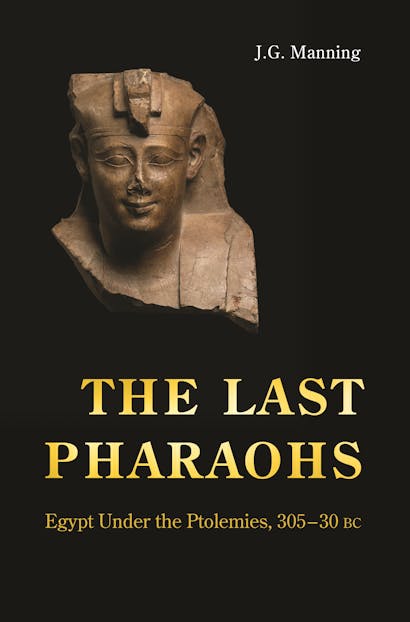
The history of Ptolemaic Egypt has usually been doubly isolated—separated both from the history of other Hellenistic states and from the history of ancient Egypt. The Last Pharaohs, the first detailed history of Ptolemaic Egypt as a state, departs radically from previous studies by putting the Ptolemaic state firmly in the context of both Hellenistic and Egyptian history. More broadly still, J. G. Manning examines the Ptolemaic dynasty in the context of the study of authoritarian and premodern states, shifting the focus of study away from modern European nation-states and toward ancient Asian ones. By analyzing Ptolemaic reforms of Egyptian economic and legal structures, The Last Pharaohs gauges the impact of Ptolemaic rule on Egypt and the relationships that the Ptolemaic kings formed with Egyptian society. Manning argues that the Ptolemies sought to rule through—rather than over—Egyptian society. He tells how the Ptolemies, adopting a pharaonic model of governance, shaped Egyptian society and in turn were shaped by it. Neither fully Greek nor wholly Egyptian, the Ptolemaic state within its core Egyptian territory was a hybrid that departed from but did not break with Egyptian history. Integrating the latest research on archaeology, papyrology, theories of the state, and legal history, as well as Hellenistic and Egyptian history, The Last Pharaohs draws a dramatically new picture of Egypt’s last ancient state.
J. G. Manning is professor of classics and history at Yale University, and a senior research scholar at Yale Law School. He is the author of Land and Power in Ptolemaic Egypt and the coeditor of The Ancient Economy: Evidence and Models.
"Manning's book is one of the most thought-provoking studies on the Hellenistic world to have appeared for quite some time, and it will be essential reading for anyone concerned with this remarkable period."—John Ray, Times Literary Supplement
"Manning has produced a deep and meaningful study of the social and political relationships inherent in the Ptolemaic economy."—Timothy Howe, Bryn Mawr Classical Review
"Following his study of land tenure and use in Hellenistic Egypt, Manning presents a well-supported analysis of the formation of the Ptolemaic state in the fourth and third centuries BCE."—Choice
"Integrating the latest research on archaeology, papyrology, theories of the state, and legal history, as well as Hellenistic and Egyptian history, The Last Pharaohs draws a dramatic picture of Egypt's last ancient state."—Heritage Key
"This book, using latest archaeological technique combined with analysis of Ptolemaic documents, sets into a clear yet far ranging perspective the reality of Egypt in a 300 year span from the ancient to the Roman world."—Stephen Cox Trust
"The Last Pharaohs has a place alongside [the works of] Gunther Holbl and Werner Huss."—Paul McKechnie, Ancient West and East
"This fascinating book has broad views that should appeal to many people who are neither specialists on ancient Egypt nor the ancient Greek world. J. G. Manning has a perfect knowledge of his subject."—Alain Bresson, University of Chicago
"Most scholars who study Ptolemaic Egypt are specialists in either Greek or Egyptian demotic papyrology, work below the level of large-scale narrative, and write technical studies that are not always accessible to historians. And the evidence from Ptolemaic Egypt is often considered parochial since Egypt is thought of as unique in the ancient world. J. G. Manning's book answers all these problems. Leaving the niche of technical papyrology and showing convincingly why Ptolemaic Egypt is important for the study of state formation and the ancient economy, he approaches the period as a real historian and puts his subject in the context of current international scholarly debate. The Last Pharaohs will impress ancient historians in general, and should make the Ptolemaic state an important case study in the literature on authoritarian states and state formation."—Katelijn Vandorpe, Katholieke Universiteit Leuven