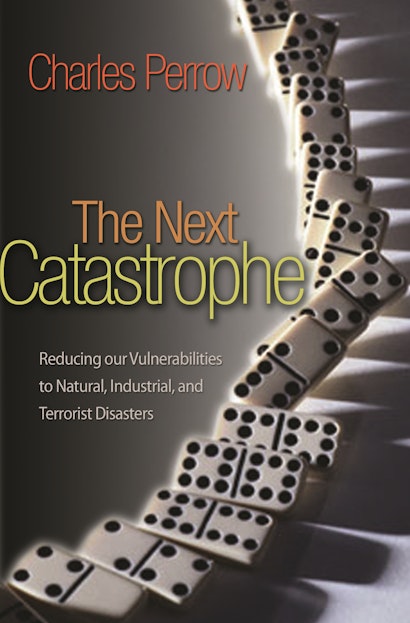
Charles Perrow is famous worldwide for his ideas about normal accidents, the notion that multiple and unexpected failures—catastrophes waiting to happen—are built into our society’s complex systems. In The Next Catastrophe, he offers crucial insights into how to make us safer, proposing a bold new way of thinking about disaster preparedness.
Perrow argues that rather than laying exclusive emphasis on protecting targets, we should reduce their size to minimize damage and diminish their attractiveness to terrorists. He focuses on three causes of disaster—natural, organizational, and deliberate—and shows that our best hope lies in the deconcentration of high-risk populations, corporate power, and critical infrastructures such as electric energy, computer systems, and the chemical and food industries. Perrow reveals how the threat of catastrophe is on the rise, whether from terrorism, natural disasters, or industrial accidents. Along the way, he gives us the first comprehensive history of FEMA and the Department of Homeland Security and examines why these agencies are so ill equipped to protect us.
The Next Catastrophe is a penetrating reassessment of the very real dangers we face today and what we must do to confront them. Written in a highly accessible style by a renowned systems-behavior expert, this book is essential reading for the twenty-first century. The events of September 11 and Hurricane Katrina—and the devastating human toll they wrought—were only the beginning. When the next big disaster comes, will we be ready? In a new preface to the paperback edition, Perrow examines the recent (and ongoing) catastrophes of the financial crisis, the BP oil spill, and global warming.
Awards and Recognition
- One of Choice's Outstanding Academic Titles for 2007
"[Perrow's] 1984 book Normal Accidents and his many publications analyzing how and why technological systems are vulnerable to disaster have achieved iconic status. In The Next Catastrophe, Perrow extends his analysis to incorporate 'natural' disasters and terrorism more fully."—American Prospect
"Perrow amply describes the failure of governmental agencies to anticipate, plan for and effectively respond to a whole series of very serious threats to our well being, if not to our very survival. . . . This is a sobering book. If enough people hear Perrow's message, the future might be ever so slightly less catastrophic."—Social Forces
"The threefold demographic vulnerabilities to disasters [described by Perrow] are well stated and merit continuing attention from scientists, engineers, emergency management practitioners, and policy makers."—American Journal of Sociology
"This book proposes a bold new way of thinking about disaster preparedness...Focusing on three causes of disaster—natural, organizational, and deliberate—he shows that our best hope lies in the deconcentration of high-risk populations, corporate power, and critical infrastructures. He also provides the first comprehensive history of the Federal Emergency Management Agency (FEMA) and the Department of Homeland Security (DHS) and examines why these agencies are so ill equipped to protect U.S. citizens."—Natural Hazards Observer
"Hurricane Katrina and the 9/11 attacks have exposed the U.S.'s vulnerabilities to natural and unnatural disasters. What should be done to prevent such catastrophes in the future? Acclaimed sociologist and systems analyst Perrow, addresses this question...The book is written in a highly readable prose that is accessible to general audiences. Indispensable for undergraduate/graduate collections in disaster management studies and risk assessment studies, and extremely useful for environmental studies and environmental sociology."—T. Niazi, Choice
"The Next Catastrophe is an important and far-reaching book that, in arguing for the reduction of vulnerabilities in critical infrastructure to natural, industrial, and terrorist disasters, tackles issues of high significance to us all. It must be hoped that the readership of this book includes not only researchers and industrial safety practitioners but also executives along with politicians at all levels and that its message is acted upon."—David M. Clarke, Risk Analysis
"The Next Catastrophe is the work of the master at his formidable best—a dazzling array of learning, perspective, good sense, and, above all, command."—Kai Erikson, Yale University
"A profound and vital book, The Next Catastrophe provides a devastating indictment of the U.S. government's response to the deep organizational faults revealed by the September 11 attacks and Katrina. Perrow shows in fascinating detail how our politicians allow human disasters to be transformed into opportunities for profiteering and politicking, and routinely substitute wasteful bureaucracies for smart plans to reorganize fragile systems. The fundamental answer, Perrow writes, is to discard the profit- and power-driven ideologies in favor of our nation's traditional common-sense approach to the challenges of our all-too-real world."—Barry C. Lynn, author of End of the Line: The Rise and Coming Fall of the Global Corporation
"A profound meditation on the paradox that modern technological and management orthodoxies have taken us down an increasingly perilous path. In the name of efficiency, sensitive industries are now so concentrated that they can be crippled at a single blow, from nature, accidents, or acts of terrorism. The mantra of asserting 'central control' in response to catastrophes only makes things worse, Perrow notes, as hierarchies strangle grassroots networks of local responders that might do some good. A trenchant, troubling study."—John Arquilla, Naval Postgraduate School
"From the opening pages, The Next Catastrophe is riveting, eye-opening, and haunting. The causes of disasters go far beyond random acts of nature or terrorism; they reflect underlying systemic and managerial issues that we must confront in order to ensure our safety. Luckily, Charles Perrow digs deeply to find some difficult but promising solutions. Concerned citizens must join the experts in reading this brilliant book."—Rosabeth Moss Kanter, Harvard Business School professor, best-selling author of Confidence: How Winning Streaks and Losing Streaks Begin and End
The Next Catastrophe is a fascinating, stimulating, and far-reaching work. Perrow's signature themes are here—the role of political and economic institutions, the reach of their power into organizations, and the inevitability of major organizational failures. The basic argument will stir discussion, and the feasibility of Perrow's proposed solutions is sure to provoke controversy."—Lynn Eden, author of Whole World on Fire: Organizations, Knowledge, and Nuclear Weapons Devastation
"Perrow's thesis is laudable and his execution is strong. When he discusses the mistakes still being made in the way the U.S. has set up FEMA and Homeland Security, he is especially strong balanced, thoughtful, and convincing—and his explanation of the Enron debacle is one of the clearest ever presented. Overall, he analyzes how our organizations fail, why it is that regulation doesn't solve the problems, and how susceptible we have become as a result, doing so in a way that is just plain splendid."—William R. Freudenburg, University of California, Santa Barbara
"Charles Perrow is the undisputed 'master of disaster.' In this timely and well-written book, Perrow offers not only a shrewd sociological diagnosis of the looming threat of (un)natural disasters, but, lo and behold, in arguing for us to shrink targets and disperse risk, he actually provides a bold yet feasible policy solution to what will surely be a growing threat to our way of life."—Dalton Conley, author of The Pecking Order: A Bold New Look at How Family and Society Determine Who We Become