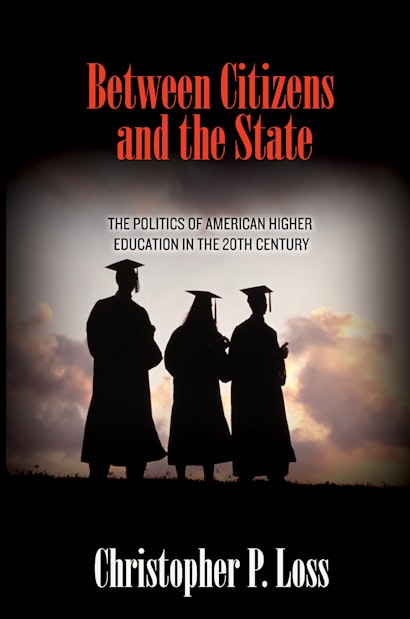
This book tracks the dramatic outcomes of the federal government’s growing involvement in higher education between World War I and the 1970s, and the conservative backlash against that involvement from the 1980s onward. Using cutting-edge analysis, Christopher Loss recovers higher education’s central importance to the larger social and political history of the United States in the twentieth century, and chronicles its transformation into a key mediating institution between citizens and the state.
Framed around the three major federal higher education policies of the twentieth century—the 1944 GI Bill, the 1958 National Defense Education Act, and the 1965 Higher Education Act—the book charts the federal government’s various efforts to deploy education to ready citizens for the national, bureaucratized, and increasingly global world in which they lived. Loss details the myriad ways in which academic leaders and students shaped, and were shaped by, the state’s shifting political agenda as it moved from a preoccupation with economic security during the Great Depression, to national security during World War II and the Cold War, to securing the rights of African Americans, women, and other previously marginalized groups during the 1960s and ’70s. Along the way, Loss reappraises the origins of higher education’s current-day diversity regime, the growth of identity group politics, and the privatization of citizenship at the close of the twentieth century.
At a time when people’s faith in government and higher education is being sorely tested, this book sheds new light on the close relations between American higher education and politics.
Awards and Recognition
- Winner of the 2013 Outstanding Book Award, American Educational Research Association
"Loss has succeeded in a very ambitious project, and shows the many ways that higher education serves as a key intermediary between state and citizen. I hope other academics will take up the challenge and build on his very good start."—Nancy L. Ruther, Times Higher Education
"Loss offers a well-researched, important narrative of the escalating involvement of federal policy in U.S. higher education from WWI through the 1970s and of the remarkable social outcomes or effects thereof. . . . Loss's book merits a place on university library shelves as well on the reading lists of courses on public policy and on the history of American higher education."—Choice
"Between Citizens and the State provides an accurate and cogent perspective on movements in American society that have led members of government and higher education to clash, but also to collaborate. Loss provides new insights on a one-hundred-year relationship that has largely been neglected by scholars."—Hani Morgan, Journal of American History
"Between Citizens and the State is an ambitious history of the politics of higher education in the twentieth century. . . . Exploring the linkage between politics as it affected higher education and the development of the social sciences is one of the significant achievements of this book."—Nannerl O. Keohane, Perspectives on Politics
"Admirably ambitious in scope and engagingly written. . . . Loss argues that political leaders and educational elites worked together to create a partnership between higher education and the state over the course of the last century. While historians of science have recognized this, Loss's important contribution to the discussion is to focus not on the collaboration's goal of producing experts and expert knowledge but on the goal of creating democratic citizens."—Rebecca Lowen, American Historical Review
"Loss' book does more than chronicle the relationship between the government and higher education; it highlights the significance of higher education's place in providing citizens a space to develop their voice, power, and political and personal identities. In doing so, it raises important questions. . . . Between Citizen and State, is an insightful and engaging look at the notion of citizenship and the political relationship that helped shape the citizen of the 20th century."—Ann Allen, Journal of Philosophy of Education
"Between Citizens and the State is well-written and effectively highlights the complex relationships between federal policy goals, the implementation of those policies by higher education organizations, and the outcomes of those efforts. The author does an excellent job of weaving details about politics and policy with the resulting impact on higher education and American society from World War I through the 1960s. . . . Institutional research professionals who have interest in the history of the politics that contributed to the growth of higher education in the United States will enjoy reading Between Citizens and the State."—Gary Lowe, Association of Institutional Research Data and Decisions
"What is the state's interest in an educated citizenry? Given Americans' historical aversion to strong central government, how has our government intervened in higher education in order to achieve that interest? How has state interest in higher education changed over time? Christopher Loss tackles these questions in his insightful survey of state interactions with higher education in the twentieth century."—Beryl Satter, Academe
"Loss offers his readers an opportunity to take a long view, narrating in his own way many elements of higher education's history that have not often been told. He provides a critical and illuminating look at the role of higher education . . . between the federal government and citizens."—Journal of Higher Education Outreach and Engagement
"Loss deserves credit for moving beyond the usual benchmarks—the GI Bill of 1944, the National Defense Education Act of 1958, and the Higher Education Act of 1965—to illuminate a longer history of subtle governmental interventions in American higher education. His well-written study also demonstrates that time and again, students took whatever educational support governmental intervention allowed yet ignored the particular lessons of citizenship the government intended to impart. In the section on higher education from the 1960s onward, Loss ably details the uneven effects of Great Society measures meant to improve educational access."—Beryl Satter, American Association of University Professors
"Institutional research professionals who have interest in the history of the politics that contributed to the growth of higher education in the United States will enjoy reading Between Citizens and the State."—Gary Lowe, Association of Institutional Research
"Loss's account is relevant to state comprehensive universities as he focuses on how the university system shifted to meet the needs of the student which were at odds with what was expected from the state."—Liz Jacoby, Teacher-Scholar
"More than just a deeply researched, nuanced history of the politics of higher education, Between Citizens and the State makes a major contribution to American political history, uncovering little known but highly significant instruments of national power and shedding new light on the complex, hidden ways government works in the modern United States."—Bruce Schulman, Boston University
"The current intense scrutiny of higher education calls for rethinking its history. An excellent place to begin is Christopher Loss's fresh and challenging interpretation. With lively case studies, he illuminates institutional responses to the nation's expanding sense of democratic values."—Hugh Hawkins, Amherst College
"Fresh and original, this exhilarating book deepens our understanding of American higher education. Crossing boundaries where persons meet institutions, structures meet their interpreters, and the state meets society, it powerfully illuminates key features of American political life that concern administration, regulation, identity, and citizenship."—Ira Katznelson, Columbia University
"Combining a vision of broad patterns of social change with a historian's appreciation of real people whose actions mattered, Christopher Loss has written a wonderfully rich analysis of the ways that universities worked in between the federal government and the people to create an educated—if conflict-ridden—democracy."—John Skrentny, University of California, San Diego
"Loss has produced a social history that connects the daily experiences of citizens touched by higher education to the grand political debates of their time. I am not aware of any other book that probes the higher education-governmental nexus in relation to the therapeutic state and this impressive work stimulates a fresh debate about how political change occurs in the United States."—Gareth Davies, University of Oxford
"Changes in the meaning of American citizenship have been powerfully shaped by the rise of higher education, with crucial implications for the polity and American society today. Addressing a surprisingly neglected but important area—the relationship between the American state and institutions of higher education throughout the mid-twentieth century—Loss illuminates the transformation in how the nation's most highly-educated citizens were educated for democracy. This rich and compelling book fills a major void."—Suzanne Mettler, Cornell University