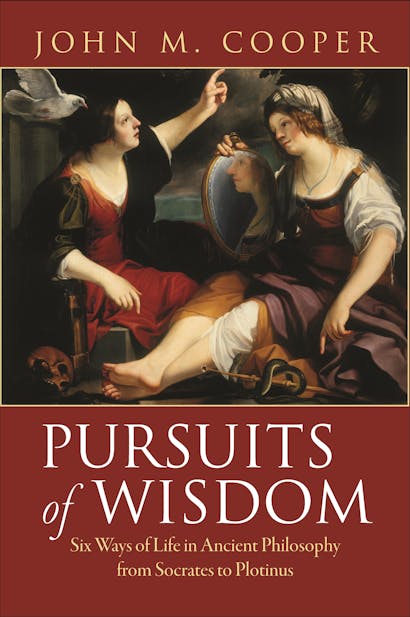
This is a major reinterpretation of ancient philosophy that recovers the long Greek and Roman tradition of philosophy as a complete way of life—and not simply an intellectual discipline. Distinguished philosopher John Cooper traces how, for many ancient thinkers, philosophy was not just to be studied or even used to solve particular practical problems. Rather, philosophy—not just ethics but even logic and physical theory—was literally to be lived. Yet there was great disagreement about how to live philosophically: philosophy was not one but many, mutually opposed, ways of life. Examining this tradition from its establishment by Socrates in the fifth century BCE through Plotinus in the third century CE and the eclipse of pagan philosophy by Christianity, Pursuits of Wisdom examines six central philosophies of living—Socratic, Aristotelian, Stoic, Epicurean, Skeptic, and the Platonist life of late antiquity.
The book describes the shared assumptions that allowed these thinkers to conceive of their philosophies as ways of life, as well as the distinctive ideas that led them to widely different conclusions about the best human life. Clearing up many common misperceptions and simplifications, Cooper explains in detail the Socratic devotion to philosophical discussion about human nature, human life, and human good; the Aristotelian focus on the true place of humans within the total system of the natural world; the Stoic commitment to dutifully accepting Zeus’s plans; the Epicurean pursuit of pleasure through tranquil activities that exercise perception, thought, and feeling; the Skeptical eschewal of all critical reasoning in forming their beliefs; and, finally, the late Platonist emphasis on spiritual concerns and the eternal realm of Being.
Pursuits of Wisdom is essential reading for anyone interested in understanding what the great philosophers of antiquity thought was the true purpose of philosophy—and of life.
Awards and Recognition
- Honorable Mention for the 2012 Award for Best Professional/Scholarly Book in Philosophy, Association of American Publishers
"[E]legant. . . . Mr. Cooper's book proves to be an antidote to the rosy nostalgia that poisons stories about what philosophy was and what it has become. . . . Unlike in the natural sciences, the central questions in philosophy are pretty much the same as they ever were: What should I believe in? How should I live? Mr. Cooper's book lucidly presents six appealing answers to those questions."—Brendan Boyle, Wall Street Journal
"In this insightful and well-written survey, Cooper presents the ancient Greek and Roman philosophical tradition as one that is unified around philosophy as a way of life. . . . Cooper offers an excellent survey that deserves a wide readership."—Choice
"Cooper's book is comprehensive, accessible, and well-written, and his claim that we could follow the ancients in allowing philosophy to steer our lives in order to understand what they were up to makes his book a provocative and worthwhile read."—Angela Schwenkler, American Catholic Philosophical Quarterly
"Cooper's attempt to write a book for a wide readership is successful. Readers interested in the subject of ancient philosophy as a way of life will find the book provocative, and those who seek a sophisticated introduction to ancient moral theory will learn a great deal from it."—Christopher Edelman, Journal of the History of Philosophy
"Pursuits of Wisdom is aimed at a 'wide readership' rather than at 'co-specialists'. Doubtless it deserves a wide readership, and as I am writing here as a 'co-specialist' I would say that it deserves reading by us too. Of course we might miss comments about the scholarly literature, but readers should be assured that Cooper is highly reliable. . . . What does 'living a philosophical life' involve? This book is a good place to go for several competing answers."—Antony Preus, Polis
"Pursuits of Wisdom is an original, clearly written, and brilliantly argued reinterpretation of six ways of life offered by ancient Greek philosophers: Socrates/Plato, Aristotle, Stoicism, Epicureanism, Skepticism, and the Platonism of Plotinus. Cooper writes vividly, with an unfaltering clarity of purpose, and he manages to balance accessibility and rigor. The book is the culmination of years of rigorous study in ancient philosophy and an invitation for a wide audience to engage seriously with these ancient ways of life. I think this invitation is worth accepting."—Antonis Coumoundouros, Philosophy in Review
"Pursuits of Wisdom is a well-written, thoroughly argued book. It undoubtedly makes an important contribution to contemporary understandings of ancient philosophy. It might even contribute to broadening the audience of those who see the relevance and seriousness of philosophy for their lives."—Ben Mulvey, Metapsychology Online Reviews
"[T]he book as a whole offers a comprehensive overview of ancient ethics that is sensitive to historical context and that tries to comprehend ancient philosophy on its own terms. Many readers will learn a lot from it."—John Sellars, Mind
"Since Socrates, philosophy has been concerned with how we ought to live. But the sense in which philosophy must be an ineluctably practical activity has become obscured. How could philosophy have ever conceived of itself as centrally concerned with its own therapeutic value? In Pursuits of Wisdom, John Cooper brings this crucial question back to life. This marvelous book will shape the way we think about and engage with ancient philosophical traditions."—Jonathan Lear, University of Chicago
"With unparalleled learning, argumentative depth, and great originality, Cooper presents a thorough rethinking of the major Greek moral philosophers. He revitalizes their visions of philosophy as a way of life and shows how they present a powerful challenge to current moral philosophy. The Greeks will never look the same again."—J. B. Schneewind, author of The Invention of Autonomy: A History of Modern Moral Philosophy
"John Cooper has had a profound impact on the scholarly study of ancient Greek and Roman philosophy, particularly in its moral dimension. In this new work, he introduces this period to a far wider audience. His sympathy and enthusiasm for the pursuits of wisdom in antiquity, and the subtlety of his understanding of these philosophical schools, will make this book a classic of its kind."—Richard Kraut, author of What Is Good and Why: The Ethics of Well-Being
"The product of a lifetime of study and thought, Pursuits of Wisdom is a detailed and rigorous analysis of the foundations of the major schools of ancient ethics in the overall philosophical systems of their authors. John Cooper's masterwork will thus be indispensable for every student of ancient philosophy in general as well as ancient ethics. But Cooper's study is also indispensable for all students of modern ethics since so much of it originates in these ancient schools. In other words, Cooper's book is simply indispensable."—Paul Guyer, University of Pennsylvania
"This book not only discusses philosophy as a way of life, but manifests many of the virtues such a life might be hoped to embody. There is scarcely an instance in which Cooper's sureness of grasp, vivacity of expression, or clarity of purpose falters. The book invites a wide readership, and should receive it."—C.D.C. Reeve, University of North Carolina, Chapel Hill