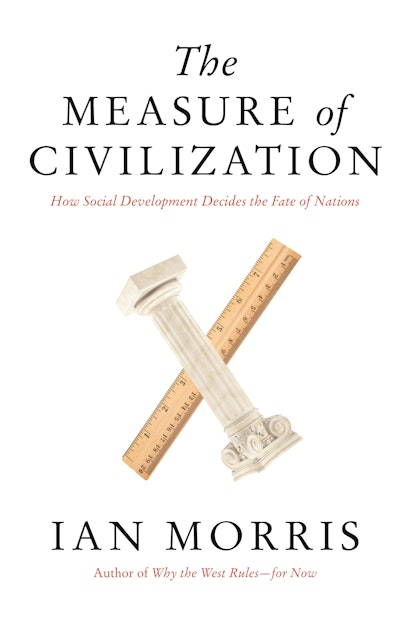
In the past thirty years, there have been fierce debates over how civilizations develop and why the West became so powerful. The Measure of Civilization presents a brand-new way of investigating these questions and provides new tools for assessing the long-term growth of societies. Using a groundbreaking numerical index of social development that compares societies in different times and places, award-winning author Ian Morris sets forth a sweeping examination of Eastern and Western development across 15,000 years since the end of the last ice age. He offers surprising conclusions about when and why the West came to dominate the world and fresh perspectives for thinking about the twenty-first century.
Adapting the United Nations’ approach for measuring human development, Morris’s index breaks social development into four traits—energy capture per capita, organization, information technology, and war-making capacity—and he uses archaeological, historical, and current government data to quantify patterns. Morris reveals that for 90 percent of the time since the last ice age, the world’s most advanced region has been at the western end of Eurasia, but contrary to what many historians once believed, there were roughly 1,200 years—from about 550 to 1750 CE—when an East Asian region was more advanced. Only in the late eighteenth century CE, when northwest Europeans tapped into the energy trapped in fossil fuels, did the West leap ahead.
Resolving some of the biggest debates in global history, The Measure of Civilization puts forth innovative tools for determining past, present, and future economic and social trends.
"Stanford University classicist and historian Morris follows up Why the West Rules—for Now with a sophisticated volume designed to add quantitative muscle to his earlier arguments. A big-history theorist working in a vein similar to Niall Ferguson or Jared Diamond, Morris measures societies' historical 'abilities to get things done in the world.' With an impressive data array, he calibrates energy resources, social organization, war-making capacity, and information technology over time to compare the East and West. In the 21st century, he foresees a shift in global power and wealth from West to East, much as it shifted from East to West in the 19th. . . . The ingenuity and style of his arguments will make economists and historians stand up and take notice."—Publishers Weekly
"Buttressed with numerous graphs and engagingly written, this work provides much food for thought."—Choice
"Using a groundbreaking numerical index of social development that compares societies in different times and places, award-winning author Ian Morris gives a sweeping examination of Eastern and Western development across 15,000 years since the end of the last ice age. He offers surprising conclusions about when and why the West came to dominate the world and fresh perspectives for thinking about the twenty-first century. . . . Resolving some of the biggest debates in global history, The Measure of Civilization puts forth innovative tools for determining past, present, and future economic and social trends."—World Book Industry
"Quantification is an invaluable tool for understanding the patterns of history. This book is to be applauded for thinking about how to measure the social competence of earlier societies."—Gregory Clark, American Historical Review
"Praise for Ian Morris: "Morris is the world's most talented ancient historian, a man as much at home with state-of-the-art archaeology as with the classics as they used to be studied.""—Niall Ferguson, Foreign Affairs
"Praise for Ian Morris: "Morris is a lucid thinker and a fine writer . . . possessed of a welcome sense of humor that helps him guide us through this grand game of history as if he were an erudite sportscaster.""—Orville Schell, New York Times Book Review
"The Measure of Civilization is a superb model of operationalizing the social sciences. A wonderful achievement."—Jared Diamond, author of Guns, Germs, and Steel
"The Measure of Civilization is a terrific book—it will inform, stimulate, and challenge you. Beautifully summarizing and quantifying the major developments in energy capture, social organization, war technology, and categorization, storage, and communication of information over the last sixteen millennia, this book shows how far we have come and how this journey has been a cumulative process."—Daron Acemoglu, coauthor of Why Nations Fail: The Origins of Power, Prosperity, and Poverty
"Ian Morris has done it again. He has enriched the argument about 'why the West rules' with a treasure trove of information about social development over the last sixteen thousand years. No one seriously interested in world or 'big' history can afford not to read this book. It clearly and consistently told me what I needed to know about the social resources that provide the indispensable context for the interpretation of culture. And it is an enormous pleasure to read. I cannot think of another book from which I have learned so much."—Robert N. Bellah, author of Religion in Human Evolution: From the Paleolithic to the Axial Age
"This is a superb book. Measuring how societies learned to harness energy better, improve their organizational and war-making capacities, and accumulate usable information, Ian Morris has developed a terrific index of social development. His fascinating conclusions and use of data will be controversial, but this book will become a classic source for anyone studying the nature of progress from sixteen thousand years ago to now."—Daniel Chirot, author of How Societies Change
"For all those interested in why the West, not the East, industrialized first, this succinct and intelligent book provides new data, a new conceptual tool, and a promising new approach to this major question. It is a valuable, critical guide to Morris's quantitative index of social development and important for his observations about what we can learn from existing work, what features of societies matter most, and what future research is needed."—Philip T. Hoffman, California Institute of Technology
"Morris's work is part of a resurgence of materialist, scientific approaches in archaeology and history. As such, many will be interested in the data and methods made available by this important book. The Measure of Civilization contains valuable and useful ideas and insights."—Michael E. Smith, Arizona State University
Praise for Ian Morris: "Ian Morris has returned history to the position it once held: no longer a series of dusty debates, nor simple stories—although he has many stories to tell and tells them brilliantly—but a true magister vitae, 'teacher of life.'"—Anthony Pagden, author of Worlds at War: The 2,500-Year Struggle between East and West