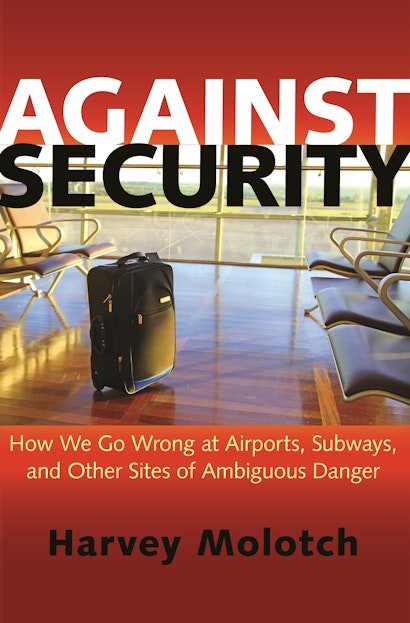
Remember when an unattended package was just that, an unattended package? Remember when the airport was a place that evoked magical possibilities, not the anxiety of a full-body scan? In the post-9/11 world, we have become focused on heightened security measures, but do you feel safer? Are you safer?
Against Security explains how our anxieties about public safety have translated into command-and-control procedures that annoy, intimidate, and are often counterproductive. Taking readers through varied ambiguously dangerous sites, the prominent urbanist and leading sociologist of the everyday, Harvey Molotch, argues that we can use our existing social relationships to make life safer and more humane. He begins by addressing the misguided strategy of eliminating public restrooms, which deprives us all of a basic resource and denies human dignity to those with no place else to go. Subway security instills fear through programs like “See Something, Say Something” and intrusive searches that have yielded nothing of value. At the airport, the security gate causes crowding and confusion, exhausting the valuable focus of TSA staff. Finally, Molotch shows how defensive sentiments have translated into the vacuous Freedom Tower at the World Trade Center site and massive error in New Orleans, both before and after Hurricane Katrina. Throughout, Molotch offers thoughtful ways of maintaining security that are not only strategic but improve the quality of life for everyone.
Against Security argues that with changed policies and attitudes, redesigned equipment, and an increased reliance on our human capacity to help one another, we can be safer and maintain the pleasure and dignity of our daily lives.
Awards and Recognition
- Winner of the 2012 PROSE Award in Sociology & Social Work, Association of American Publishers
- One of Choice's Outstanding Academic Titles for 2013
"Mr. Molotch . . . present(s) a vivid picture of the ways in which poorly designed security measures can deform everyday life and defeat themselves."—Jordan Ellenberg, Wall Street Journal
"America's obsession with safety makes us angry, alienated, and ultimately less safe, argues this penetrating study of public security. Sociologist Molotch criticizes a range of security structures and protocols: airport security gates that require useless and humiliating body searches while generating long lines that make tempting targets for terrorists; ill-conceived New Orleans water projects that precipitated the Hurricane Katrina flood, and the militarized disaster response that further endangered residents. Even gender-segregated public restrooms (co-ed restrooms, he contends, would be more convenient and safer for women). Molotch recommends simple hardware and procedural improvements, from better stairways and signage to assist evacuations to customer-service regimens that help employees spot trouble. More than that, he argues for a conceptual shift away from rigid, rule-bound 'command and control' toward a security philosophy that empowers ordinary people to handle crises through spontaneous order and mutual aid. Molotch shrewdly analyzes the ways in which anxious, stressed-out people interact with their physical and social environments in a lively, engaging prose that skewers the verities of the post-9/11 security state. The result is a far-reaching re-examination of our culture of public fear, one that stands conventional wisdom on its head."—Publishers Weekly
"The author is concerned with the complex systems that permit us to feel safe in public places. He traces a path from public toilet facilities through subways and airports to the reconstruction of Ground Zero before taking on the catastrophic effects of nature in the hurricane damage and flooding of New Orleans in 2005. Molotch treats each phase of the narrative separately and considers the design and organization of space, entries, and exits, fields of vision and patterns of activity, whether encouraged or not. The author's approach to public spaces as an environment permits an insightful, provocative treatment of whether the security we seek is fostered or not—and if so, how. . . . A humane, well-researched examination of privacy and security issues."—Kirkus Reviews
"Against Security is an interesting book that will appeal to all sorts of readers, published by a prestigious academic press, and retaining some of the trappings of a serious academic study. It never falters in presenting interesting and thought-provoking stories, which will make it attractive to an audience much broader than social scientists."—David E. Spiro, New York Journal of Books
"Terrorism is the weapon of the disaffected; it has been invented; it cannot be disinvented. Public pressure and the politicians' need to be seen to 'do something' will bring more security counter-measures. Molotch is right to say that their conduct must be improved."—Omar Malik, Times Higher Education
"In Against Security, Molotch takes aim at a 'command-and-control' approach to subway and airport safety, flood protection, and the war on terror. He makes a compelling case that security requires 'considered judgments based on empirical evidence cleansed of anxieties of fear and vengeance.' And he suggests specific changes, small and large, to enhance safety without diminishing civil liberties or the everyday enjoyment of life, that deserve our attention."—Barron's
"Molotch is not anti-security; he calls for and offers some suggestions for better designs and architecture. A challenging book, then, to spark thought among all security people."—Professional Security Magazine
"A lot of psychological research has tried to make sense out of security, fear, risk, and safety. But however fascinating the academic literature is, it often misses the broader social dynamics. New York University's Harvey Molotch helpfully brings a sociologist's perspective to the subject in his new book Against Security."—Bruce Schneier, Reason
"This is one of the most significant volumes available highlighting alternatives to the paranoia surrounding the war on terror, and it deserves a place on the shelf of all academic libraries."—Choice
"Against Security is worth the price of admission for Molotch's analysis of the TSA's airport screening system. . . . Reading Against Security is a terrific way for us to re-examine our assumptions and our methods. This is a book that both informs about the microsystems of airport screening, subway platforms, and public restrooms while making us think about the larger societal tradeoffs we make to ensure our safety."—InsideHigherEd.com
"Molotch's . . . commitment to exploring positive alternatives advances a global debate—one that has only just begun—over the need to invent genuinely progressive arts of security."—Austin Zeiderman, Public Books
"Molotch brings both wisdom and remarkable skills to this compelling book, including a prose style that is rich, lively, and a pleasure to read. With keen eye and gifted hand, as well as clear, hard data, he puts the subject of Against Security into context and offers thoughtful and sensible solutions to the problems he draws our attention to."—Kai T. Erikson, author of A New Species of Trouble: Explorations in Disaster, Trauma, and Community
"This remarkable, original book analyzes the frequently misguided efforts of government to instill in people a sense of security. What makes Against Security so unusual is that it goes beyond critique to sympathetic recognition of people's fears, understanding the motives that lead politicians and the public to act in seemingly irrational ways, and recommending practical measures with which to confront threat without transgressing dignity."—Susan S. Fainstein, Harvard University Graduate School of Design
"A breakthrough—Against Security is an original contribution to social theory and a dazzling critique of how security is managed in everyday life and in situations of crisis."—Anthony Giddens, former director of the London School of Economics and Political Science
"This is a major sociological contribution to public debates about the increased security governments across the world have introduced to anticipate risks and prevent disasters. Molotch skillfully connects public fears about security to the private anxieties and intense inequalities these measures have generated, and he urges alternative human strategies developed from daily routines and mutuality."—Bridget M. Hutter, London School of Economics and Political Science
"A mesmerizing exploration of the things that scare us, Against Security exposes the even more frightening unintended consequences of government actions in response. Molotch takes us from the recesses of public restrooms and subways to the workplace, the Katrina disaster, air travel, and the World Trade Center site. His remedies combine expertise with common sense and imagination. A must-read, this is the book for our time."—Diane Vaughan, author of The Challenger Launch Decision: Risky Technology, Culture, and Deviance at NASA
"Smart, savvy, and life-affirming, Against Security is the much-needed antidote to today's security regime—a regime that, despite its best efforts, succeeds mostly in making everyone's life worse. With his deeply-researched critique of what goes wrong, and his designer's eye for how things might be improved, Molotch has given us an instant sociological classic that is as enjoyable as it is essential."—David Garland, author of The Culture of Control and Peculiar Institution
"In this extremely important and beautifully written book, Molotch offers a highly original reflection on the current quest for security in the United States. His profound insights point out a plethora of expensive problems we have created for ourselves. He offers a solid list of alternative responses that might well avoid these kinds of devastating consequences."—Christina Nippert-Eng, Illinois Institute of Technology