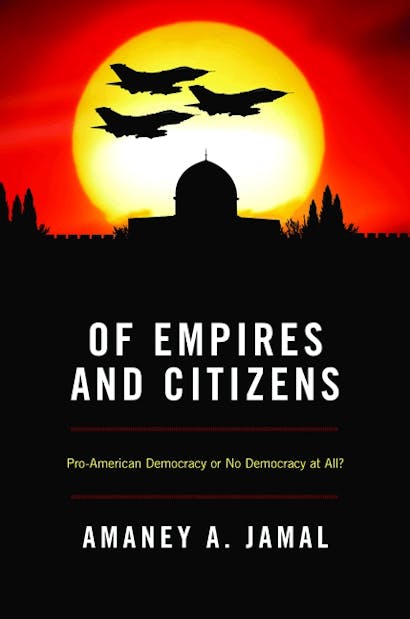
In the post-Cold War era, why has democratization been slow to arrive in the Arab world? This book argues that to understand support for the authoritarian status quo in parts of this region—and the willingness of its citizens to compromise on core democratic principles—one must factor in how a strong U.S. presence and popular anti-Americanism weakens democratic voices. Examining such countries as Jordan, Kuwait, Morocco, Palestine, and Saudi Arabia, Amaney Jamal explores how Arab citizens decide whether to back existing regimes, regime transitions, and democratization projects, and how the global position of Arab states shapes people’s attitudes toward their governments.
While the Cold War’s end reduced superpower hegemony in much of the developing world, the Arab region witnessed an increased security and economic dependence on the United States. As a result, the preferences of the United States matter greatly to middle-class Arab citizens, not just the elite, and citizens will restrain their pursuit of democratization, rationalizing their backing for the status quo because of U.S. geostrategic priorities. Demonstrating how the preferences of an international patron serve as a constraint or an opportunity to push for democracy, Jamal questions bottom-up approaches to democratization, which assume that states are autonomous units in the world order. Jamal contends that even now, with the overthrow of some autocratic Arab regimes, the future course of Arab democratization will be influenced by the perception of American reactions. Concurrently, the United States must address the troubling sources of the region’s rising anti-Americanism.
Amaney A. Jamal is associate professor of politics at Princeton University and the author of Barriers to Democracy (Princeton).
"[A] provocative work that challenges the terms of a very stale debate among three main camps: those who see Arab anti-Americanism as the product of a deep, unique civilizational hatred; those who see anti-Americanism as simple and predictable resentment of the world's sole superpower, common across the globe and not unique to Arab countries; and those who see it as a rational response to U.S. policies that Arabs believe have systematically harmed their interests. . . . If Jamal is right, then much of the received wisdom of the last decade needs to be reconsidered."—Marc Lynch, Foreign Affairs
"Contrasting the prospects for democratization in Jordan and Kuwait, Jamal argues that Jordanians prefer a stable monarchy to a democracy dominated by anti-American Islamists because they fear that the US would punish Jordan economically if Islamists won elections. . . . [Of Empires and Citizens] makes a nice addition to the comparative politics literature by emphasizing how geostrategic relations shape state-society negotiations over political change. . . . [R]eaders will gain many insights about Jordanian and Kuwaiti political beliefs from the public opinion surveys and interviews from 2005 to 2007 that the author interprets."—Choice
"The book reflects a huge academic effort, a 'massive data collection effort in three countries' of Jordan, Morocco and Kuwait. The effort is reflected by the thorough presentation of evidence."—James Denselow, Huffington Post
"The book has a readable style that is not over-burdened with technical jargon. Challenging traditional culturalist and structuralist explanations for the lack of democracy in the Middle East, it uses core-periphery theory an as explanatory framework for authoritarian resilience."—Alexander P. Martin, New Middle Eastern Studies
"The book reflects a huge academic effort, a 'massive data collection effort in three countries', Jordan, Morocco and Kuwait. The effort is reflected by the thorough presentation of evidence: the work includes detailed foot- and endnotes, chapter appendices complete with snippets of the author's methodology, questionnaires and further hypotheses. . . . Through this evidence-based look into the relationships between client and patron and between state and society, Jamal explores a simple idea, demonstrated well."—James Denselow, International Affairs
"This original book adds to the substantial research concerned with domestic factors and the persistence of authoritarianism in the Arab world. It also opens a new line of inquiry by demonstrating the role of international factors in relationships between the Arab governments and the United States. An impressive and rich work."—Mark Tessler, University of Michigan
"This book shows that democracy in the Middle East threatens the interests of the middle classes who rely heavily on American aid. They fear that democracy will bring to power populists wishing to undermine American regional hegemony resulting in a loss of their aid lifeline. The book's compelling argument and its relevance to current policy concerns are significant."—David Laitin, Stanford University
"Arguing that the lack of democratization in the Middle East is tied to the critical role the United States plays in the region, this strong book extends our understanding of how international relations affects citizens' perceptions and engagement with the state."—Ellen Lust, Yale University
"Jamal makes a persuasive case for an important but never-before tested argument: U.S. policy in the Arab world has been one of the principal obstacles to democratic development in the region. A wonderful addition to debates about impediments to democracy, the sources and consequences of anti-Americanism, and the character of U.S. foreign policy, this book is essential reading."—Lisa Anderson, American University in Cairo