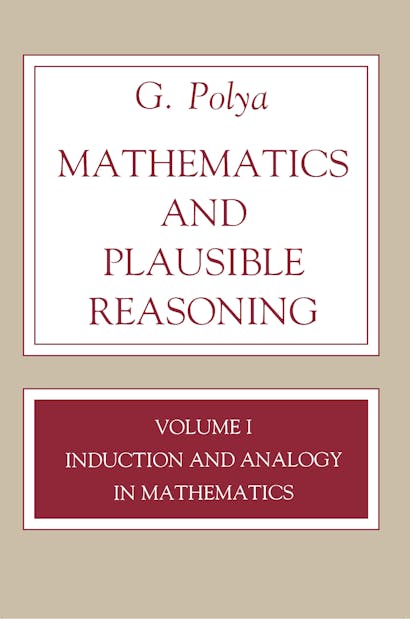
Mathematics and Plausible Reasoning, Volume 1: Induction and Analogy in Mathematics
Paperback
- Price:
- $44.00/£35.00
- ISBN:
- Published:
- Aug 23, 1990
- Copyright:
- 1954
- Pages:
- 298
- Size:
- 6 x 9.25 in.
- Main_subject:
- Mathematics
ebook
A guide to the practical art of plausible reasoning, this book has relevance in every field of intellectual activity. Professor Polya, a world-famous mathematician from Stanford University, uses mathematics to show how hunches and guesses play an important part in even the most rigorously deductive science. He explains how solutions to problems can be guessed at; good guessing is often more important than rigorous deduction in finding correct solutions. Vol. I, on Induction and Analogy in Mathematics, covers a wide variety of mathematical problems, revealing the trains of thought that lead to solutions, pointing out false bypaths, discussing techniques of searching for proofs. Problems and examples challenge curiosity, judgment, and power of invention.