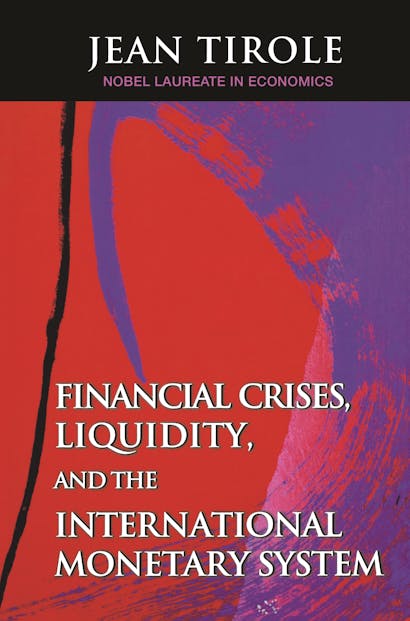
Once upon a time, economists saw capital account liberalization—the free and unrestricted flow of capital in and out of countries—as unambiguously good. Good for debtor states, good for the world economy. No longer. Spectacular banking and currency crises in recent decades have shattered the consensus. In this remarkably clear and pithy volume, one of Europe’s leading economists examines these crises, the reforms being undertaken to prevent them, and how global financial institutions might be restructured to this end.
Jean Tirole first analyzes the current views on the crises and on the reform of the international financial architecture. Reform proposals often treat the symptoms rather than the fundamentals, he argues, and sometimes fail to reconcile the objectives of setting effective financing conditions while ensuring that a country “owns” its reform program. A proper identification of market failures is essential to reformulating the mission of an institution such as the IMF, he emphasizes. Next he adapts the basic principles of corporate governance, liquidity provision, and risk management of corporations to the particulars of country borrowing. Building on a “dual- and common-agency perspective,” he revisits commonly advocated policies and considers how multilateral organizations can help debtor countries reap enhanced benefits while liberalizing their capital accounts.
Based on the Paolo Baffi Lecture the author delivered at the Bank of Italy, this refreshingly accessible book is teeming with rich insights that researchers, policymakers, and students at all levels will find indispensable.
Awards and Recognition
- Jean Tirole, Winner of the 2014 Nobel Prize in Economics
Jean Tirole, the winner of the 2014 Nobel Prize in Economics, is chairman of the Foundation Jean-Jacques Laffont at the Toulouse School of Economics, scientific director of Toulouse's Industrial Economics Institute, and annual visiting professor of economics at the Massachusetts Institute of Technology. His books include The Theory of Corporate Finance (Princeton), The Theory of Industrial Organization, Game Theory (with Drew Fudenberg), and A Theory of Incentives in Procurement and Regulation (with Jean-Jacques Laffont).
"An insightful contribution to the expanding economics research that reexamines the role of the International Monetary Fund in emerging markets and financial crises."—Choice
"In this remarkably ambitious and insightful book, Jean Tirole tackles the core issues in the economics of international lending with his usual superb clarity of thought. This book is essential reading to anyone interested in understanding the economics behind the recent drive to improve the international financial architecture."—Ken Rogoff, Chief Economist and Director of Research, International Monetary Fund
"Jean Tirole is living proof of the value of good economic thinking. He shines new light on, and dissipates heat from, every issue he touches. In this book he offers us an amazing combination of detailed facts and rigorous theory about international financial crises. His perspective of dual and common agencies enriches our understanding of the roles and shortcomings of international economic institutions, and points the way to reform. All the supposed experts who engage in controversies on these matters should learn from this book."—Avinash Dixit, Princeton University
"This book presents one of the first comprehensive attempts to bring rigorous theoretical foundations into the debate on the international financial architecture. The analysis is simple, elegant, and yields insights that are often unconventional and always thought-provoking. This is an indispensable reference for all economists interested in the current debates on the international financial architecture."—Olivier Jeanne, International Monetary Fund
"Most proposals for reforming the international financial system derive from ad hoc explanations for recent crises. Jean Tirole goes back to first principles. He asks how relations between lenders and borrowers differ in the international context from those in the domestic context. You may not agree with all of his conclusions but will have to rethink your own views after you have read it."—Peter B. Kenen, Princeton University
"Jean Tirole uses the tools of corporate finance to analyse some key aspects of international finance. As we expect from him, we get deep and fruitful insights into issues such as borrower and lender behavior, the appropriate role of the IMF, and private sector involvement in orderly workouts. This is essential reading for all those concerned with the 'international financial architecture.'"—Richard Portes, London Business School