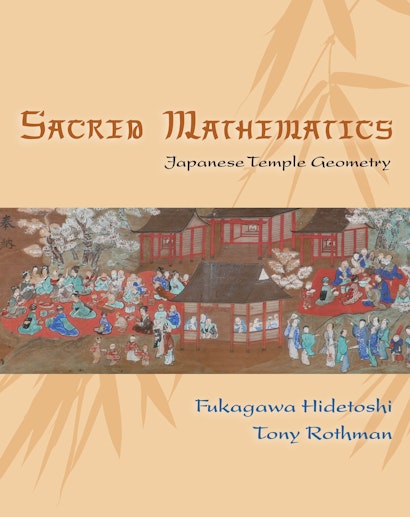
Between the seventeenth and nineteenth centuries Japan was totally isolated from the West by imperial decree. During that time, a unique brand of homegrown mathematics flourished, one that was completely uninfluenced by developments in Western mathematics. People from all walks of life—samurai, farmers, and merchants—inscribed a wide variety of geometry problems on wooden tablets called sangaku and hung them in Buddhist temples and Shinto shrines throughout Japan. Sacred Mathematics is the first book published in the West to fully examine this tantalizing—and incredibly beautiful—mathematical tradition.
Fukagawa Hidetoshi and Tony Rothman present for the first time in English excerpts from the travel diary of a nineteenth-century Japanese mathematician, Yamaguchi Kanzan, who journeyed on foot throughout Japan to collect temple geometry problems. The authors set this fascinating travel narrative—and almost everything else that is known about temple geometry—within the broader cultural and historical context of the period. They explain the sacred and devotional aspects of sangaku, and reveal how Japanese folk mathematicians discovered many well-known theorems independently of mathematicians in the West—and in some cases much earlier. The book is generously illustrated with photographs of the tablets and stunning artwork of the period. Then there are the geometry problems themselves, nearly two hundred of them, fully illustrated and ranging from the utterly simple to the virtually impossible. Solutions for most are provided.
A unique book in every respect, Sacred Mathematics demonstrates how mathematical thinking can vary by culture yet transcend cultural and geographic boundaries.
Awards and Recognition
- Winner of the 2008 PROSE Award in Mathematics, Association of American Publishers
"Now Fukagawa Hidetoshi, a mathematics teacher, and writer Tony Rothman present a collection of Sangaku problems in their book, Sacred Mathematics. The puzzles range from simple algebra within the grasp of any intermediate-school student, to challenging problems that require graduate-school mathematics to solve. Copious illustrations and many detailed solutions show the scope, complexity, and beauty of what was tackled in Japan during the Tokugawa shogunate."—Peter J. Lu, Nature
"Fascinating and beautiful book."—Physics World
"This book is the most thorough (and beautiful) account of Japanese temple geometry (sangaku) available."—Paul J. Campbell, Mathematics Magazine
"The difficult problems with complete solutions and rich commentary that comprise the heart of this book will interest every mathematics student."—Choice
"This is a marvelous book. Good books are not just written or compiled, they are crafted. Sacred Mathematics is a well crafted work that combines mathematics, history and cultural considerations into an intriguing narrative. . . . The writing style is appealing and the organization of material excellent. Princeton University Press must be congratulated on producing this quality publication and offering it at an agreeable price. This book is highly recommended for personal reading and library acquisition. It should be especially appealing to problem solvers."—Frank J. Swetz, Convergence
"A unique book in every respect. Sacred Mathematics demonstrates how mathematical thinking can vary by culture yet transcend cultural and geographic boundaries."—International Institute for Asian Studies Newsletter
"The Fukagawa-Rothman collaboration on Sacred Mathematics: Japanese Temple Geometry makes this book much more than an anecdotal or exotic cultural artifact. It is an original, dynamic tool for all interested in mathematics and in a better understanding of Japanese cultural life under the Tokugawa shogunate. It challenges our modern educational methods and is well worth having in a library or in the classroom."—Jean Constant, Mathematical Intelligencer
"An enchanting history of Japanese geometry—of a time and place where 'geometers did not cede place to poets.' This intersection of science and culture, of the mathematical, the artistic, and the spiritual, is packed, like circles within circles, with rewarding Aha! epiphanies that drive a mathematician's curiosity."—Siobhan Roberts, author of King of Infinite Space
"Teachers will welcome this remarkable collection of mathematical problems, history, and art, which will enrich their curriculum and promote both logical thinking and critical evaluation. It is especially important that we maintain an interest in geometry, which needs, and for once gets, more than its share."—Richard Guy, coauthor of The Book of Numbers
"This remarkable book provides a novel insight into the Japanese mathematics of the past few hundred years. It is fascinating to see the difference in mathematical style from that which we are used to in the Western world, but the book also elegantly illustrates the cross-cultural Platonic nature and profound beauty of mathematics itself."—Roger Penrose, author of The Road to Reality
"A significant contribution to the history of mathematics. The wealth of mathematical problems—from the very simple to quite complex ones—will keep the interested reader busy for years. And the beautiful illustrations make this book a work of art as much as of science. Destined to become a classic!"—Eli Maor, author of The Pythagorean Theorem: A 4,000-Year History
"A pleasure to read. Sacred Mathematics brings to light the unique style and character of geometry in the traditional Japanese sources—in particular the sangaku problems. These problems range from trivial to utterly devilish. I found myself captivated by them, and regularly astounded by the ingenuity and sophistication of many of the traditional solutions."—Glen Van Brummelen, coeditor of Mathematics and the Historian's Craft