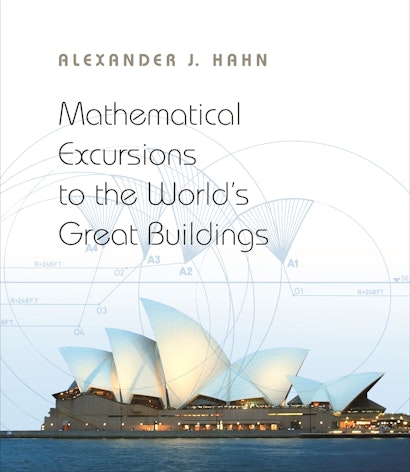
From the pyramids and the Parthenon to the Sydney Opera House and the Bilbao Guggenheim, this book takes readers on an eye-opening tour of the mathematics behind some of the world’s most spectacular buildings. Beautifully illustrated, the book explores the milestones in elementary mathematics that enliven the understanding of these buildings and combines this with an in-depth look at their aesthetics, history, and structure. Whether using trigonometry and vectors to explain why Gothic arches are structurally superior to Roman arches, or showing how simple ruler and compass constructions can produce sophisticated architectural details, Alexander Hahn describes the points at which elementary mathematics and architecture intersect.
Beginning in prehistoric times, Hahn proceeds to guide readers through the Greek, Roman, Islamic, Romanesque, Gothic, Renaissance, and modern styles. He explores the unique features of the Pantheon, the Hagia Sophia, the Great Mosque of Cordoba, the Duomo in Florence, Palladio’s villas, and Saint Peter’s Basilica, as well as the U.S. Capitol Building. Hahn celebrates the forms and structures of architecture made possible by mathematical achievements from Greek geometry, the Hindu-Arabic number system, two- and three-dimensional coordinate geometry, and calculus. Along the way, Hahn introduces groundbreaking architects, including Brunelleschi, Alberti, da Vinci, Bramante, Michelangelo, della Porta, Wren, Gaudí, Saarinen, Utzon, and Gehry.
Rich in detail, this book takes readers on an expedition around the globe, providing a deeper understanding of the mathematical forces at play in the world’s most elegant buildings.
Awards and Recognition
- Winner of the 2012 PROSE Award in Architecture & Urban Planning, Association of American Publishers
- One of Choice's Outstanding Academic Titles for 2013
"[Hahn] conducts an opulent historical and geographical tour."—Jascha Hoffman, New York Times Book Review
"Modern architects rely on algebra and calculus. Hahn turns these tools on historical structures from the Parthenon to the Hagia Sophia to St. Paul's Cathedral, revealing how they hold up and explaining the causes of visible contortions and cracks. . . . More engrossingly, Hahn employs mathematics to explore how architects have conceived of buildings through the ages. In the case of Milan's cathedral, Hahn's discussion is especially rich because his maths plays out against a backdrop of detailed historical documentation, including the testimony of the German [master builder]."—Jonathon Keats, New Scientist
"[H]andsomely produced and lavishly illustrated. . . . Hahn tends to avoid discussing some of the aesthetic versus engineering limitations in favor of explaining how things work. And in that area he can be very helpful to the experienced architecture fan and the novice as well. . . . The mathematical sections are well illustrated and pictures of buildings abound. . . . No effort has been spared to make this an informative and aesthetically pleasing book. And the problems are fun too."—Gerald L. Alexanderson, MAA Reviews
"I cannot recommend this book highly enough. This is a lucidly written, beautifully illustrated, hugely informative volume. . . . Mathematics apart, this book is just plainly an absorbing and informative read. . . . The book is lavishly illustrated—both its architectural and mathematical strands come pretty much alive in the abundance of drawings and diagrams. From this perspective, the book must be very suitable for an advanced Liberal Arts mathematics course; however the aesthetic focus of the book makes it a cultural phenomenon. I would suggest consulting the book before a trip to Europe, Middle East, or Australia. Technical details and depth of coverage brought to you by Alexander Hahn are certain to complement more common travel guides."—CTK Insights
"Rich, insightful and detailed, the book is a pleasurable excursion if you want to go beyond a peek at the buildings. Drawings and colour images add understanding to the narration."—Vaidehi Nathan, Organiser
"It is not only a picture book but also a book that is a pleasure to read from cover to cover and I can imagine that after reading it, after a while one will pick it up again and again to just enjoy the illustrations or reread sections and chapters."—A. Bultheel, European Mathematical Society
"A great building has a formal beauty, and it is no surprise that one can understand such buildings through mathematics. Hahn considers numerous buildings such as the Parthenon, the Hagia Sophia, the US Capitol, and the Sydney Opera House, providing a tour through the history of architecture with care and appropriate detail. . . . The author balances the richness of the buildings with the generous development of the mathematical topics, including polygonal geometry, trigonometry, symmetry, conic sections, perspective, and the calculus—all leavened with the problems of transferring loads and stable structures. . . . Hahn has served up a beautiful mix of mathematics, architecture, and history, and he has made it accessible to most readers. This book belongs in every library; it is a treasure trove of wonders."—Choice
"The book is very readable and well written as a textbook. Readers only need to know some basic high school mathematics. It is very well illustrated with graphics that follow the text and plates in color of the most important buildings that are considered. At the end of each chapter, there are problems and discussions that help the reader to better understand the underlying mathematics. The discussions are particularly interesting because they provide a lot of background information. They cover a range of topics, from the golden rectangle, symmetry and the geodesic triangle to medieval building practices and Gaudi's forms. The book also contains a glossary of architectural terms for the reader's convenience."—Vesna Velickovic, Mathematical Reviews Clippings
"Many exercises contained in the book are a great material for interdisciplinary courses and teacher's training."—D. Ciesielska, Zentralblatt MATH
"I commend this book for its interesting and original insights into Archimedes' far-reaching discoveries."—Phill Schultz, Australian Mathematical Society
"I recommend this book for advanced survey courses or special topics courses."—Craig McBride, Mathematics Teacher
"The mathematical analysis of building structures is essential to the understanding of architecture. Yet most texts available are abstract and not specific to the importance of such study. At last, Alexander Hahn has provided a thorough and beautifully illustrated mathematical look at the world's greatest buildings that will remedy this void and provide a relevant and absorbing study for architects and others interested in the art of building. I particularly found the description of the amazing structural problem of the Sydney Opera House not only interesting but exciting."—John Burgee, fellow of the American Institute of Architects
"Readers who enjoy connecting mathematics to real-world applications will find this book intriguing, as will anyone who wants to learn more about the forces and mathematics behind the construction of the world's great buildings."—Michael Huber, author of Mythematics
"Clear and engaging, this terrific book contains interesting and authentic mathematical applications. Mathematical Excursions to the World's Great Buildings is a book you can curl up with and enjoy."—Marc Frantz, Indiana University