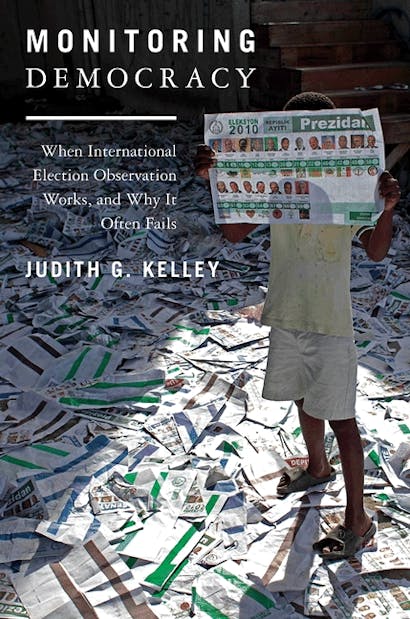
In recent decades, governments and NGOs—in an effort to promote democracy, freedom, fairness, and stability throughout the world—have organized teams of observers to monitor elections in a variety of countries. But when more organizations join the practice without uniform standards, are assessments reliable? When politicians nonetheless cheat and monitors must return to countries even after two decades of engagement, what is accomplished? Monitoring Democracy argues that the practice of international election monitoring is broken, but still worth fixing. By analyzing the evolving interaction between domestic and international politics, Judith Kelley refutes prevailing arguments that international efforts cannot curb government behavior and that democratization is entirely a domestic process. Yet, she also shows that democracy promotion efforts are deficient and that outside actors often have no power and sometimes even do harm.
Analyzing original data on over 600 monitoring missions and 1,300 elections, Kelley grounds her investigation in solid historical context as well as studies of long-term developments over several elections in fifteen countries. She pinpoints the weaknesses of international election monitoring and looks at how practitioners and policymakers might help to improve them.
Awards and Recognition
- Co-Winner of the 2013 Chadwick F. Alger Prize, International Studies Association
- One of Choice's Outstanding Academic Titles for 2013
"Monitoring Democracy is an impressive attempt to assess the success of international election monitoring by systematically comparing several hundred monitoring missions across the globe. . . . [Kelley] also offers extensive concrete suggestions for improving monitoring in the future. This book addresses a major gap in the literature, in which there are numerous individual case studies but little serious comparative work. It is, therefore, mandatory reading for election monitoring professionals and for scholars doing research in that area."—Choice
"Monitoring Democracy provides an insightful analysis of a topic of utmost policy relevance. Kelley carefully considers confounding factors, selection problems and possible biases in the data. The book touches on many interesting questions, and even offers advice to practitioners. The data work is impressive, both in terms of the codification of monitors' reports and the number of case-studies."—Karina Cendon Bóveda, International Affairs
"Kelley has produced a fine piece of scholarship that should be required reading for scholars interested in democracy promotion, as well as practitioners. The analysis is careful, broad, and admirably conversant in the details of specific countries and elections. . . . One of her greatest contributions is the associated data set, which is publicly available and codes for both the characteristics of the monitoring missions and their detailed evaluations. Hence, interested researchers are amply supplied with the theoretical and empirical tools to build on Kelley's work."—Michael K. Miller, Perspectives on Politics
"[T]his hook provides a rich, cogent, and thought-provoking entry point. It is essential reading for those interested in democracy promotion, international organizations and norms, and international influences on domestic politics."—Daniela Donno, Political Science Quarterly
"Monitoring Democracy stands out as a major landmark in studies on the ways and waywardness of international election observers."—Manu V. Devadevan, Human Rights Review
"This probing, nuanced, and insightful analysis of international election monitoring splendidly illuminates and assesses a key area of international democracy support. The book's conclusions about the mixed utility and many dilemmas of election monitoring are persuasive and deserve wide attention. Extra kudos to Judith Kelley for providing an all-too-rare example of sophisticated, rigorous political science methods being brought to bear on the domain of democracy promotion."—Thomas Carothers, Carnegie Endowment for International Peace
"Judith Kelley has written not only the definitive book on election monitoring for scholars and practitioners, but also an important new work on the modern practice of democracy itself. Her persuasive and carefully conducted analysis of election monitoring reveals its positive effects as well as its ambiguities and shortcomings. Election monitoring organizations should make Monitoring Democracy required reading for all their staff."—Kathryn Sikkink, University of Minnesota
"In this book, Judith Kelley shows her skills as a political detective, demonstrating with impressive social science that under certain conditions—not all—election monitoring promotes democracy. If you read only one book on election monitoring, read Monitoring Democracy."—Robert O. Keohane, Princeton University
"This timely book provides the first inclusive study of election monitoring as it has developed since the mid-1970s. It contains strong arguments, meticulous analysis, and a genuine understanding of the complexities of individual elections throughout the world."—Jørgen Elklit, Aarhus University
"No other book compares the operations of different monitoring organizations and offers such a comprehensive overview of their effectiveness."—Amanda Sives, University of Liverpool
"Monitoring Democracy answers a host of foundational questions about international election observation. What is novel about this book—and what stands as Judith Kelley's singular achievement—is her comprehensive and systematic collection of evidence. Her interpretation of this evidence is, happily, always nuanced, judicious, and just plain smart. A must-read book."—Frederic C. Schaffer, University of Massachusetts, Amherst