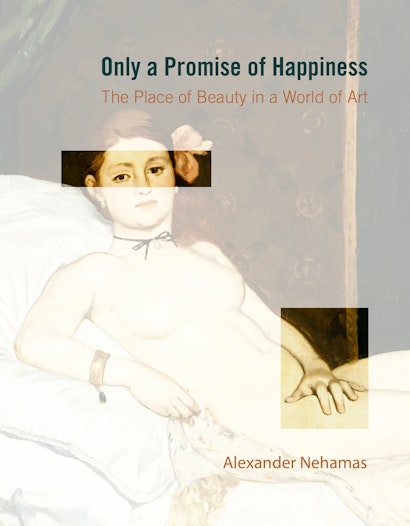
Neither art nor philosophy was kind to beauty during the twentieth century. Much modern art disdains beauty, and many philosophers deeply suspect that beauty merely paints over or distracts us from horrors. Intellectuals consigned the passions of beauty to the margins, replacing them with the anemic and rarefied alternative, “aesthetic pleasure.” In Only a Promise of Happiness, Alexander Nehamas reclaims beauty from its critics. He seeks to restore its place in art, to reestablish the connections among art, beauty, and desire, and to show that the values of art, independently of their moral worth, are equally crucial to the rest of life.
Nehamas makes his case with characteristic grace, sensitivity, and philosophical depth, supporting his arguments with searching studies of art and literature, high and low, from Thomas Mann’s Death in Venice and Manet’s Olympia to television. Throughout, the discussion of artworks is generously illustrated.
Beauty, Nehamas concludes, may depend on appearance, but this does not make it superficial. The perception of beauty manifests a hope that life would be better if the object of beauty were part of it. This hope can shape and direct our lives for better or worse. We may discover misery in pursuit of beauty, or find that beauty offers no more than a tantalizing promise of happiness. But if beauty is always dangerous, it is also a pressing human concern that we must seek to understand, and not suppress.
Awards and Recognition
- Winner of the 2007 Best Professional/Scholarly Book in Philosophy, Association of American Publishers
"Mr. Nehamas sets about reclaiming something of beauty's lost meaning by showing how it is connected to our happiness. . . . That . . . a work could infuriate one age and become an icon to the next fascinates Mr. Nehamas, who is drawn to works where our aesthetic and moral obligations come into conflict. . . . Mr. Nehamas displays an admirable clarity of thought and language. . . . [W]e can enjoy this book as we might the conversation of a spirited and quirky friend whose most irritating pronouncements are the ones we find ourselves mulling over, with some surprise, a week or two later."—Michael J. Lewis, Wall Street Journal
"Alexander Nehamas seeks to reestablish the connections among art, beauty and desire and to show that the values of art are critical."—Publishers Weekly
"[A] marvelous book...Nehamas sets out to retrieve beauty on behalf of all those who still use the word 'beautiful' with everyday pleasure: of a child, a landscape, a vase of flowers, an automobile. He does so in a tone of easy familiarity and enviable gracefulness; this is the philosopher not as blunt pragmatist, like the great Richard Rorty, nor as dour sceptic like W. V. Quine, but as winning and witty guide, and genial companion."—Mike Hulme, Times Higher Education Supplement
"A wonderful, personal, and philosophic essay concerned with the restoration of beauty's place in art . . . a rich conversation of ideas and feelings."—Reamy Jansen, Bloomsbury Review
"Because our most meaningful encounters with beauty unfold over time, we can only ever say in retrospect that a beautiful object has not made our lives—or our culture—better. . . . Beauty is only ever that promise: There is no a priori judgment that might reveal what will prove evanescent and what sustaining. . . . In Mr. Nehamas's vision, the possibility of beauty is well worth the price of uncertainty."—Gideon Lewis-Kraus, New York Sun
"[A] gracious and insightful book. . . . The best parts of the book, which deal with the intimate love of beauty, are gloriously intelligent without being at all difficult and wise without being pompous."—John Armstrong, Sydney Morning Herald
"Nehamas . . . thinks that beauty has been too narrowly defined and that both the pro-beauty camp and the anti-beauty camp have painted us into a tight corner. Only a Promise of Happiness is his attempt to free us from the enclosure. . . . Nehamas feels that beauty deserves a second chance because he thinks that the war on beauty has restricted what we can hope to expect from both art and life. . . . [A] sane and provocative book."—Christopher Benfey, Slate.com
"The power of beauty, its call to our love and its capacity to move us, is the focus of Only a Promise of Happiness, a new and very welcome book by Princeton philosopher Alexander Nehamas."—John Armstrong, The Australian
"[Nehamas] writes with philosophical depth and great clarity and grace. His thoughts are lively and provocative, and he argues that the question of beauty (what is beautiful to me might not be beautiful to you) and the value of art are not rarefied topics, but part of the fabric of our everyday lives."—Nancy Tousley, Calgary Herald
"Nehamas' language itself is fascinating, often giving rise to thoughts that in themselves are worth contemplating."—Regis Schilken, Blog Critics Magazine
"Every practicing art critic could benefit from reading Nehamas's feeling account. But this shouldn't keep anyone whose curiosity is aroused by the title from picking up this engaging book. Nehamas . . . writes with philosophical depth and great clarity and grace. His thoughts are lively and provocative, and he argues that the question of beauty (what is beautiful to me might not be beautiful to you) and the value of art are not rarefied topics, but part of the fabric of our everyday lives."—Nancy Tousley, Calgary Herald
"If we are to take beauty seriously, Nehamas argues, we have to admit that it is impossible to really understand it without also understanding love.... Nehamas has done us the service of returning the question of beauty to the center of humanistic attention. Only a Promise of Happiness raises important questions about the relationship between knowing and loving."—Joseph Phelan, Weekly Standard
"This book contains material for constructive discussion and may even prompt some of us to reconsider the role beauty could or should play not only in the realm of art but in other aspects of our lives."—Giles Auty, The Australian
"Nehamas, who wrote important studies on Plato and Nietzsche, is one of the most brilliant, amazing and amusing philosophers of our day. Though many other thinkers surely are as important as he, few rival his elegance, for he cultivates these almost forgotten qualities among scholars: writing well and wit. From its extrinsic features to the inmost convictions of its author, Only a Promise of Happiness is a notable book."—José Baracat Jr., Consciousness, Literature and the Arts
"Nehamas's argument about beauty in art is beautiful, in the very sense intended by the argument itself."—Carolyn Wilde, Modernism/Modernity
"The quality of the thought and writing of Nehamas's book assures that it will be required reading for a long time to come. It is the achievement of a wise and literate thinker in whose thought and life the topic of beauty is a matter of urgent and abiding concern. It takes readers into a discourse that in its nature addresses issues that arise in their own lives. Like truth and goodness, beauty is one of the determinants of human life, a fundamental value whose pertinence rules out the possibility that anyone can put it to rest and settle, once and for all, the problems that belong to its essence."—Arthur C. Danto, Professor Emeritus, Columbia University
"Alexander Nehamas is one of the most imaginative philosophers of our day, as well as one of the most learned. In the past he has written brilliantly about both Plato and Nietzsche. In Only a Promise of Happiness he tries to reconcile the two by showing how their accounts of beauty complement each another. His attempt is novel and very ambitious. It seems to me almost completely successful."—Richard Rorty, Professor Emeritus, Stanford University
"Alexander Nehamas's brave ambition is to bridge the gap between philosophy and art criticism. Writing as a philosopher with a great interest in art history, he uses a wide range of examples, from high art and mass art, from the visual arts and literature. Most philosophers in the analytic tradition write in a detached way. Nehamas, by contrast, presents an account of great feeling. This is a great, bravely provocative analysis. There is nothing else like this in the literature."—David Carrier, Case Western Reserve University and Cleveland Institute of Art