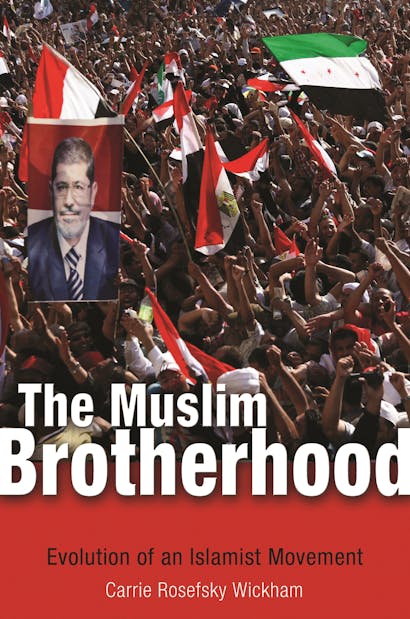
The Muslim Brotherhood has achieved a level of influence nearly unimaginable before the Arab Spring. The Brotherhood was the resounding victor in Egypt’s 2011-2012 parliamentary elections, and six months later, a leader of the group was elected president. Yet the implications of the Brotherhood’s rising power for the future of democratic governance, peace, and stability in the region is open to dispute. Drawing on more than one hundred in-depth interviews as well as Arabic language sources not previously accessed by Western researchers, Carrie Rosefsky Wickham traces the evolution of the Muslim Brotherhood in Egypt from its founding in 1928 to the fall of Mubarak and the watershed elections of 2011-2012. Further, she compares the Brotherhood’s trajectory with those of mainstream Islamist groups in Jordan, Kuwait, and Morocco, revealing a wider pattern of change. Wickham highlights the internal divisions of such groups and explores the shifting balance of power among them. She shows that they are not proceeding along a linear path toward greater moderation. Rather, their course has been marked by profound tensions and contradictions, yielding hybrid agendas in which newly embraced themes of freedom and democracy coexist uneasily with illiberal concepts of Shari’a carried over from the past. Highlighting elements of movement continuity and change, and demonstrating that shifts in Islamist worldviews, goals, and strategies are not the result of a single strand of cause and effect, Wickham provides a systematic, fine-grained account of Islamist group evolution in Egypt and the wider Arab world.
Awards and Recognition
- Honorable Mention for the 2015 Hubert Morken Award for Best Book, Religion and Politics Section of the American Political Science Association
- One of Choice's Outstanding Academic Titles for 2014
- One of The Middle East Channel’s Top Five Books of 2013, chosen by Marc Lynch
"The Muslim Brotherhood has been pushed out of power in Egypt and Carrie Rosefsky Wickham . . . might appear to be publishing just too late. In fact, her book still matters."—Gerard Russell, Times Literary Supplement
"[F]ine-grained, historically rich analysis."—Charles Tripp, London Review of Books
"This timely publication emerges from Emory University political scientist Wickham's (Mobilizing Islam) long-term research into the institutional and ideological nuances of 'movement changes' within the Muslim Brotherhood—the Sunni revivalist organization that was the leading opponent of the Mubarak regime in Egypt before the popular uprising of January 2011. . . . This admirable study (based on hundreds of interviews) is a judicious, well-grounded plea for complexity in the depiction and analysis of Islamist movements."—Publishers Weekly
"[F]ascinating and marvelously detailed. . . . The Muslim Brotherhood offers one of the best and most detailed presentations of a robust school of thought among students of Islamism. . . . [I]t is likely to become a standard text and will be received as a major summary statement of decades of research and analysis."—Marc Lynch, Democracy: A Journal of Ideas
"In this richly researched book, Wickham provides the most in-depth analysis of the genesis and development of Egypt's Muslim Brotherhood available in English. . . . This valuable contribution to the literature on mainstream Islamist movements will be useful to scholars and policymakers alike."—Library Journal
"[A] clearly written and balanced account of the Brotherhood from its modest beginnings to its coming to power."—Michael Burleigh, Literary Review
"[A] commanding study of the Brotherhood's long history."—Frederick Deknatel, National
"[An] excellent new history of the Muslim Brotherhood."—Christopher de Bellaigue, Guardian
"[O]utstanding. . . . The Muslim Brotherhood is an essential guide to understanding the historical background of the political crisis in Egypt today."—Joseph Richard Preville, Muscat Daily
"Given Egypt's crucial position as the Arab world's most populous nation, it is especially welcome that Emory University's Carrie Rosefsky Wickham, has written The Muslim Brotherhood, an accessible and informative analysis of one of the most important and perhaps most misunderstood political organizations in the Middle East. . . . Wickham's book provides a fascinating historical account of the Muslim Brotherhood and its development over the decades."—Matthew Feeney, American Conservative
"Wickham's thoughtful presentation of the Muslim Brotherhood as both a significant historical player and a responsive ideological organization may serve to deepen our understanding of current upheavals in the Arab world. Fascinating, revealing, and impressive in scope, Wickham's book stands to make important contributions to contemporary studies of the Middle East."—Michelle Anne Schingler, Foreword
"[The Muslim Brotherhood] is a careful analysis that is meticulous in questioning the data from a position of critical reflection, demonstrating many years of research and experience and a genuine understanding of the region and its complexities by not taking simple statements at face value. . . . The extent to which analysis of this kind can derive valid causal inferences from observed data hinges on the contextual knowledge of the researcher, and it is here that this work truly excels. . . . The Muslim Brotherhood: Evolution of an Islamist Movement is not just a timely new book on a topic of public interest but a fine example of academic research."—Christina Hellmich, Times Higher Education
"[W]hatever transpires the Muslim Brotherhood will be key players, whether in government or on the street, and this excellent work of historical analysis will be essential reading for all those who want a grounded and informed understanding of events."—Dr. Charles H. Middleburgh, Middleburgh Blog
"Highlighting elements of movement continuity and change, and demonstrating that shifts in Islamist worldviews, goals, and strategies are not the result of a single strand of cause and effect, Wickham provides a systematic, fine-grained account of Islamist group evolution in Egypt and the wider Arab world."—World Book Industry
"The Muslim Brotherhood is an excellent place to start the quest to understand the Brotherhood and their central role in recent events. Wickham's finely tuned analysis takes us only to the election of Mohamed Morsi on June 30, 2012. Yet, rather than date her study, the cascade of events that followed has only served to heighten its value."—Raymond William Baker, Middle East Journal
"Carrie Wickham brings years of thoughtful research, experience in the field, and careful reflection to her new book on the Muslim Brotherhood. The book, which is meticulously detailed and superbly sourced, is a pleasure to read and advances robust theoretical and empirical claims. . . . Wickham's book is a masterful telling of the trajectory of the contemporary Egyptian Muslim Brothers."—Joshua Stacher, International Journal of Middle East Studies
"[The Muslim Brotherhood] provides a nuanced and rich analysis of the transformation of the Brotherhood from its inception in the 1920s until its rise to power in 2011-12. . . . This book is a must read not only for students of Egypt and the Muslim Brotherhood but also for all those interested in the evolution of social and political movements in the Middle East and beyond."—Choice
"Wickham's work is a valuable introduction to the Muslim Brotherhood and Islamist movements in the Arab world. It is timely and relevant and promises to advance a much-needed discussion of the complexity of Islamist movements and their political endeavours."—Dalal Daoud, International Journal
"Wickham's book provides a solid guide to the Muslim Brotherhood."—Wolfgang G. Schwanitz, Middle East Quarterly
"Carrie Rosefsky Wickham has authored a singularly important work for those especially interested in learning how religiously representative Egyptians think about their lives and the way forward. The author is commended for her labor and diligence and notably for her exploration of the mindset that has captured the fascination of people the world over."—Lawrence Ziring, Review of Politics
"A timely and incisive look into the history, politics, and future of the Muslim Brotherhood by the foremost expert on Islamism in Egypt. Carrie Rosefsky Wickham has constructed a detailed account of how the Brotherhood confronts the challenges before it, and why and when it embraces change. Everyone concerned with the future of Egypt should read this book."—Vali Nasr, author of The Shia Revival and The Dispensable Nation
"Meticulously researched and powerfully argued, Carrie Rosefsky Wickham's The Muslim Brotherhood is the most significant book about the Egyptian brotherhood since the publication in 1969 of Richard P. Mitchell's The Society of the Muslim Brothers. Essential for understanding the Egyptian uprising of 2011 and its aftermath."—James L. Gelvin, author of The Arab Uprisings: What Everyone Needs to Know
"Given the profound political changes taking place in Egypt today, Wickham's in-depth, richly composed, and intimate analysis of the Muslim Brotherhood has never been so relevant or timely. This is a first-rate book on an important topic, written by a distinguished scholar, and utilizing an impressive array of sources."—John P. Entelis, Fordham University
"Until now, there was no study that provides a portrait of the Muslim Brotherhood from its founding in the 1920s to today, and Wickham's comparative analysis of Jordan, Kuwait, and Morocco is unique in the literature. What is also distinctive about this book is that it does not concentrate on the extremism of Islamist movements, but rather on how they may become more active participants in regular political processes."—John O. Voll, Georgetown University