Book Search:  


Google full text of our books:

bookjacket

Taking the Constitution Away from the Courts
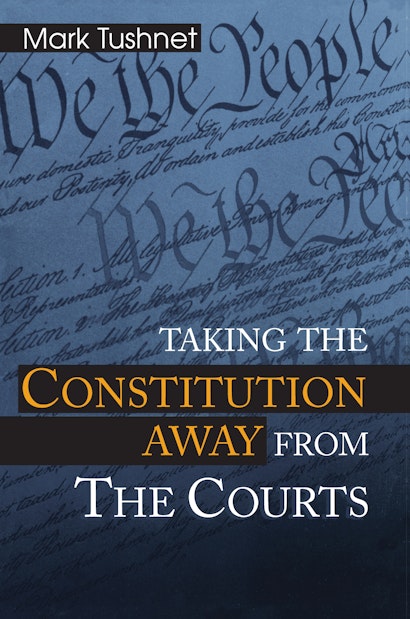
Mark Tushnet

Paper | 2000 | $30.95 / £21.95
254 pp. | 6 x 9

e-Book | 2001 | $30.95 | ISBN: 978-1-4008-2297-3

Shopping Cart | Reviews | Table of Contents

Google full text of this book:
 

Here a leading scholar in constitutional law, Mark Tushnet, challenges hallowed American traditions of judicial review and judicial supremacy, which allow U.S. judges to invalidate "unconstitutional" governmental actions. Many people, particularly liberals, have "warm and fuzzy" feelings about judicial review. They are nervous about what might happen to unprotected constitutional provisions in the chaotic worlds of practical politics and everyday life. By examining a wide range of situations involving constitutional rights, Tushnet vigorously encourages us all to take responsibility for protecting our liberties. Guarding them is not the preserve of judges, he maintains, but a commitment of the citizenry to define itself as "We the People of the United States." The Constitution belongs to us collectively, as we act in political dialogue with each other--whether in the street, in the voting booth, or in the legislature as representatives of others.

Tushnet urges that we create a "populist" constitutional law in which judicial declarations deserve no special consideration. But he warns that in so doing we must pursue reasonable interpretations of the "thin Constitution"--the fundamental American principles embodied in the Declaration of Independence and the Preamble to the Constitution. A populist Constitution, he maintains, will be more effective than a document exclusively protected by the courts. Tushnet believes, for example, that the serious problems of the communist scare of the 1950s were aggravated when Senator Joseph McCarthy's opponents were lulled into inaction, believing that the judicial branch would step in and declare McCarthy's actions unconstitutional. Instead of fulfilling the expectations, the Court allowed McCarthy to continue his crusade until it was ended. Tushnet points out that in this context and in many others, errors occurred because of the existence of judicial review: neither the People nor their representatives felt empowered to enforce the Constitution because they mistakenly counted on the courts to do so. Tushnet's clarion call for a new kind of constitutional law will be essential reading for constitutional law experts, political scientists, and others interested in how and if the freedoms of the American Republic can survive into the twenty-first century.

Reviews:

"A valuable addition to the swelling chorus of 'judicial review' skeptics. . . . a book-length defense of this interesting heresy."--Richard Posner, The New Republic

"Tushnet . . . makes a bold and compelling argument against judicial review as the primary means of constitutional reform, arguing that this tradition takes lawmaking out of the hands of the people and relinquishes it to the courts."--Booknews

"[Tushnet's] ideas will challenge and inform academics, lawyers, and college students interested in the foundations of the American political system. . . . This bold analysis for 21st-century constitutional interpretation is highly recommended."--Library Journal

"Both at the turn of the last century and at the turn of this one, the American courts have shown that they are willing to stand shoulder-to-shoulder with those who oppose progressive reform. Mark Tushnet's work is a welcome sign that at last the tide is beginning to turn, and that American law professors are no longer willing to be complicit in this obstructionism."--Jeremy Waldron, Times Literary Supplement

Endorsements:

"This is a thoroughly fascinating book by one of our major constitutional thinkers. What makes the book especially notable is that Tushnet not only assesses the possibility of constitutional interpretation outside the courts, but also goes on to deliver an assault on what might be termed constitutional interpretation 'inside' the judiciary. That is, the book becomes a ringing attack on judicial review. This will, no doubt, occasion much debate."--Sanford Levinson, University of Texas at Austin

"A major work-a potential classic that promises also to be an academic bestseller. . . . Tushnet demonstrates that the case for judicial review and thick constitutionalism is far, far more complex than previous theorists have recognized. Any person who wants to defend those principles in the future will have to deal with the claims of this book."--Mark Graber, University of Maryland

Table of Contents:

Preface
Prologue3
Ch. 1Against Judicial Supremacy6
Ch. 2Doing Constitutional Law Outside the Courts33
Ch. 3The Question of Capability54
Ch. 4The Constitutional Law of Religion Outside the Courts72
Ch. 5The Incentive-Compatible Constitution95
Ch. 6Assessing Judicial Review129
Ch. 7Against Judicial Review154
Ch. 8Populist Constitutional Law177
Notes195
Bibliography227
Index237

This book has been translated into:

  • Chinese (Complex)

Other Princeton books by Mark Tushnet:

Subject Areas:

Shopping Cart:

For customers in the U.S., Canada, Latin America, Asia, and Australia

Paper: $30.95 ISBN13: 978-0-691-07035-3

For customers in Europe, Africa, the Middle East, and India

Paper: £21.95 ISBN13: 978-0-691-07035-3

Our e-Book editions are available from many of these online vendors

Prices subject to change without notice

File created: 6/4/2009

Questions and comments to: webmaster@press.princeton.edu
Princeton University Press

New Book E-Mails
New In Print
PUP Blog
Subjects
Catalogs
Series
Sample Chapters
Podcasts/Vodcasts
Recent Awards
Google Settlement
E-Books
Online Books
Online Ordering
For Reviewers
Class Use
Permissions
About Us
Contact Us
European Office
Links
F.A.Q.
Home Page
Send me emails
about new books in:
Political Science and International Relations
Political Philosophy
Law
More Choices
Email:
Country:
Name: